

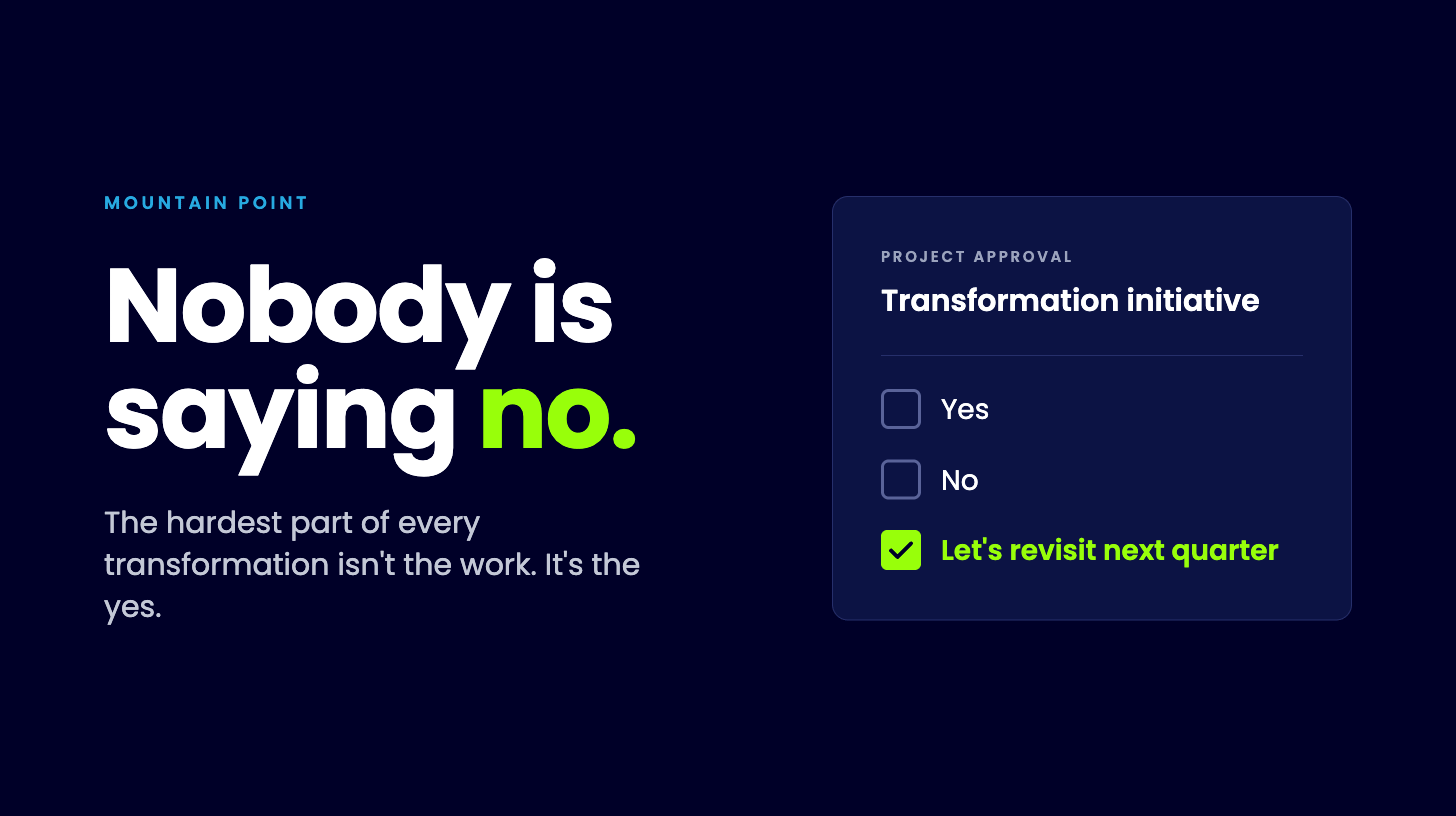
This year, at least five projects we’ve scoped have stalled in the same place.
Not lost. Stalled. Each one started the same way: a business process held together by a few key people and a handful of spreadsheets, systems that were implemented but never finished, and leadership that knows AI is about to raise the bar before they’re ready. Everyone agreed on the problem. Everyone wanted it fixed.
Then the meetings started. New stakeholders joined. Requirements got revised. Another round of demos. A proposal, then a revised proposal.
Lots of motion. No movement.
We call that the rocking horse, and right now it’s the most common state a transformation project can be in.
Everyone in the Room Has Been Burned Before
Walk into any leadership team today and you’re not talking to a blank slate. You’re talking to people who lived through the last one.
The ERP rollout that was supposed to take a year and took three. The CRM that went live on schedule and then got quietly abandoned by the people it was built for. The “transformation” that transformed mostly the budget. The integration that still breaks every month-end, years later.
That history doesn’t stay in the past. It walks into every new evaluation.
It shows up as more stakeholders, added as insurance. As longer requirements lists, written as protection. As requests for guarantees no honest partner can give. As a sponsor who believes in the project but remembers what happened to the last person who championed one.
And it shows up as fatigue. Teams that spent years absorbing change they didn’t ask for, learning systems that didn’t stick, and cleaning up after go-lives, have very little appetite left for another round. Nobody says “we’re too tired to do this.” They say “let’s revisit next quarter.”
This is scar tissue, and it’s rational. These organizations learned something real from past projects. The problem is what they learned: that the safest move is not to move.
Every Stakeholder Is Solving for a Different Failure
Here’s where the scar tissue turns into a stall.
The business side wants speed, because the last project took forever. Finance wants control, because the last one blew the budget. IT wants fewer platforms, because they’re still supporting the last one. Operations wants less disruption, because they absorbed the last go-live.
Each of those is legitimate. They’re just not the same project. Every person at the table is protecting against a different bad memory.
When nobody has agreed on the one outcome that matters most, every proposal looks wrong to somebody. So nobody says no. They just don’t say yes.
The RFP Is Where Alignment Goes to Hide
The standard fix for misalignment is a formal process. Write an RFP, gather requirements, evaluate vendors objectively.
In practice, it often does the opposite. A 200-line requirements list is usually five departments’ wish lists stapled together. Nobody had to decide what mattered most, because everything made the list. The disagreement didn’t get resolved. It got formatted.
And by the time it’s released, it’s stale. An RFP takes months to write, route, and approve. In that window the AI roadmap shifted, vendors announced new products, a sponsor changed roles, and the budget got reset. Vendors respond to a document that describes last year’s problem.
To be fair to buyers: partners contribute to this too. When we answer a fatigued, misaligned committee with a transformation-sized proposal, we’re asking them to relive exactly the thing they’re afraid of.
Waiting Has a Cost Nobody Tracks
While the project idles, the costs keep running. Work still waits on manual handoffs. Errors still leak through exceptions nobody tracks. Your best people still spend their week patching the process instead of improving it.
Those costs are quiet and spread across the business. The cost of a new project is loud and concentrated. So the quiet cost wins every time.
What Actually Breaks the Stall
In the projects that do move, two things are almost always true.
They agreed on one outcome first. Not a requirements list. One measurable result that every department signed off on before anyone talked about platforms.
They made the bet small enough to trust. Scar tissue doesn’t heal with a better pitch. It heals with evidence. A fixed-scope, time-boxed engagement that shows something working in weeks does more to rebuild confidence than any business case. If it works, the next step is easy to approve. If it doesn’t, you’ve lost a quarter, not a year.
Neither requires knowing which AI platform wins. Documenting how your business actually runs, and cleaning up the logic behind it, pays off on any platform. That’s the foundation AI runs on.
A Test for Your Stalled Project
If there’s a project on your desk that everyone agrees on and nobody has approved, ask each stakeholder, separately, two questions:
What’s the one outcome this has to deliver?
And what went wrong the last time we tried something like this?
If the answers to the first question match, you’re ready to move. If they don’t, the answers to the second will tell you why.
Reply and tell me what you heard. I’m genuinely curious how common this is.