

Enterprise software has gone through several eras.
First, the advantage came from implementing systems that digitized work.
Then it shifted to integrating those systems.
Today, AI is becoming the next wave.
But I think we’re asking the wrong question.
The conversation shouldn’t be, “How do we use AI?”
It should be, “How does work need to change?”
Because AI agents don’t transform businesses.
Operating models do.
The Next Competitive Advantage
For years, companies invested in CRM, CPQ, ERP, customer service, and analytics platforms.
The assumption was simple: better software would create better outcomes.
Sometimes it did.
More often, it digitized existing processes without fundamentally changing how work moved through the business.
Sales still relied on manual handoffs.
Engineering still reviewed every exception.
Operations still validated orders before they reached ERP.
Finance still reconciled pricing after the quote was approved.
Customer service still inherited whatever information survived the journey.
The software changed. The operating model didn’t.
AI is exposing that reality.
Every AI Discussion Eventually Becomes a Workflow Discussion
Most AI initiatives begin with technology.
Which model should we use?
Which platform should we buy?
Where should we start?
Those are reasonable questions.
But they don’t stay the important questions for long.
Very quickly, the conversation changes.
Who owns this decision?
Where does this information come from?
Which system is the source of truth?
Who approves pricing exceptions?
Can the agent access customer data?
Should it be allowed to submit an order?
Can finance trust the output?
None of these are AI questions. They’re workflow questions.
And workflow is where transformation succeeds or fails.
Data Matters. Decisions Matter More.
There’s a lot of discussion about preparing data for AI.
That’s important.
But structured data alone isn’t enough.
Agents also need structured decisions.
Consider a complex manufacturing quote.
The product model defines what can be configured.
Pricing policies determine what can be discounted.
Approval rules define when human oversight is required.
Order validation ensures downstream teams can execute what was sold.
Those aren’t simply pieces of data.
They’re business decisions.
If those decisions exist only in tribal knowledge, spreadsheets, email chains, or individual experience, an agent has nothing reliable to execute.
The challenge isn’t giving AI more information.
It’s giving the business more consistency.
Applications Are Becoming Implementation Details
For decades, enterprise software was organized around applications.
CRM
CPQ
ERP
Customer Service
Each system had its own owner, roadmap, and implementation team.
But customers don’t experience applications.
They experience outcomes.
They don’t care which system generated the quote.
They care that it was accurate.
They don’t care how many approvals happened internally.
They care that the order arrived on time.
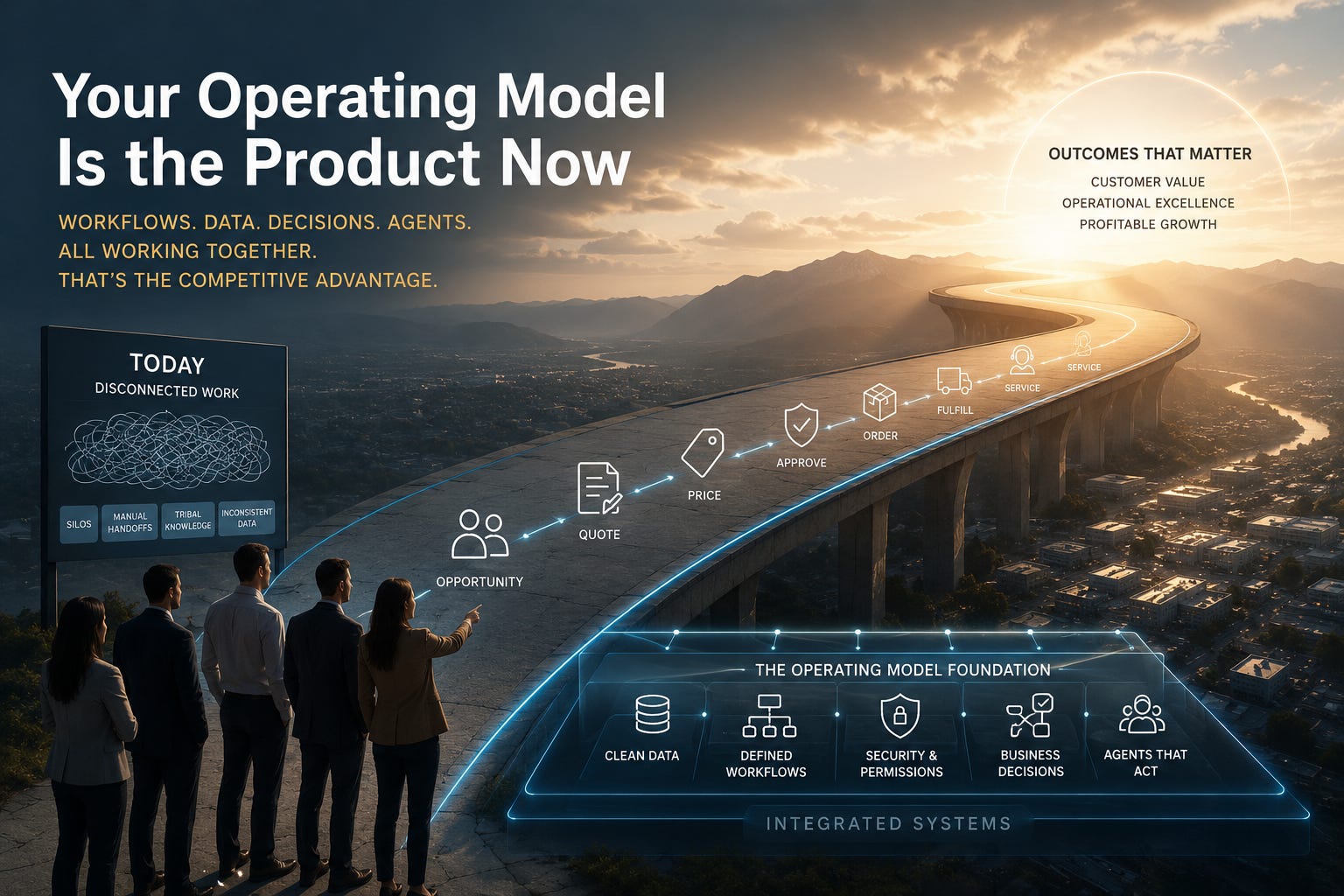
As agents begin working across functions, applications become less important than the workflows connecting them.
The workflow becomes the experience.
The operating model becomes the product.
This Changes the Role of IT
For years, IT was often viewed as the organization that implemented and supported enterprise systems.
That role is expanding.
Agents don’t live inside one department.
They operate across sales, operations, finance, engineering, service, and fulfillment.
That requires governance.
Security
Permissions
Data architecture
Integration
Business logic
IT isn’t becoming more important because of AI.
It’s becoming more central because the workflows themselves are becoming digital assets that span the entire organization.
But IT can’t do this alone.
Revenue leaders, operations, finance, engineering, and service teams all own part of the workflow.
The future operating model has to be designed together.
Lead-to-Cash Is the Best Place to Start
Revenue operations sits at the intersection of nearly every function in the business.
A single customer request can touch sales, engineering, pricing, finance, manufacturing, fulfillment, and customer service.
That’s exactly why lead-to-cash is such a valuable place to evaluate agent readiness.
Every unnecessary approval
Every manual pricing review
Every spreadsheet
Every rekeyed order
Every engineering exception
Every downstream correction
These aren’t just inefficiencies.
They’re signals that the operating model still depends on people bridging gaps between systems.
Agents won’t eliminate those gaps. They’ll make them visible.
The Real Work Begins Before the Agent
The organizations creating the most value with AI aren’t simply deploying more agents.
They’re redesigning how work moves through the business.
They’re clarifying decision ownership.
Standardizing policies.
Reducing unnecessary handoffs.
Connecting systems around outcomes instead of departments.
Only then do agents become powerful.
Not because they’re intelligent.
Because the business has become understandable.
The Takeaway
AI is rapidly becoming part of every enterprise platform.
Soon, every company will have access to capable models.
That won’t be the differentiator.
The differentiator will be how well organizations redesign the work those models support.
Companies that continue to optimize individual applications will see incremental improvements.
Companies that redesign their operating model will unlock something much bigger.
Because in the agent era, your operating model isn’t just how your business runs.
It’s your competitive advantage.