

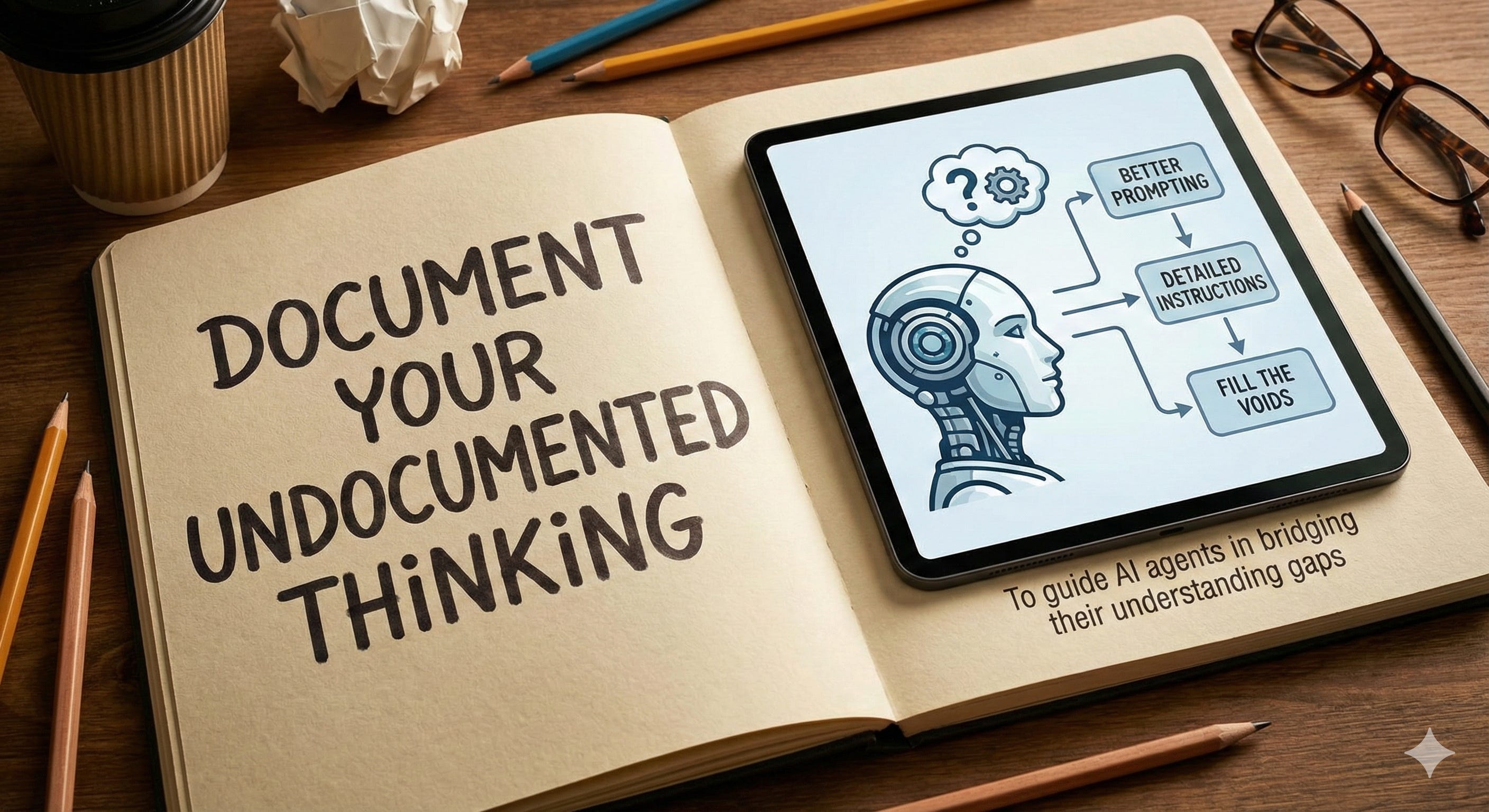
For years, the most valuable work inside companies has lived in people’s heads.
Not in systems. Not in documentation. Not in dashboards.
It lived in instincts. In experience. In knowing how to navigate exceptions, edge cases, and workarounds that were never written down.
That undocumented thinking became job security. It was how people differentiated themselves. It was how organizations functioned, quietly and imperfectly.
AI changes that.
From Tribal Knowledge to Explicit Instructions
AI does not understand nuance unless it can be expressed. It cannot act on instinct. It requires direction, structure, and context.
Which means the moment you introduce AI into a workflow, you are forced to answer a hard question:
Do you actually know how your business works?
Not how you think it works. Not how the policy document says it works. How it actually works when things go wrong, when data is missing, and when customers do something unexpected.
That knowledge has always existed. It was just scattered across Slack messages, side conversations, heroic employees, and “that one person who knows how this really works.”
AI does not eliminate that thinking. It surfaces it. And once it is surfaced, it is no longer protected by obscurity.
Job Security Used to Live in Ambiguity
For a long time, ambiguity was a form of leverage. If only you knew how to fix a certain problem or run a certain report or navigate a certain system, your value was unquestioned.
The problem is that ambiguity does not scale. And AI thrives on things that scale.
What used to make someone indispensable is now what makes a process un-automatable.
So when people say they are afraid AI will “take their job,” what they often mean is this:
They are afraid it will take ownership of what they used to hold privately.
AI Is Not Replacing Work. It Is Rewriting the Instructions
Every effective use of AI starts the same way. Someone has to stop and translate real-world work into clear, testable steps.
That is not a technical exercise. It is an operational one.
It requires people who deeply understand the business and can explain it precisely. What triggers an action. What exceptions matter. What data can be trusted. What decisions are subjective and which must be standardized.
In that sense, AI does not replace expertise. It demands that expertise finally be made explicit.
Why So Many AI Projects Stall
Most AI initiatives do not fail because the models are weak. They fail because the thinking is fuzzy.
Messy processes create messy training data. Messy training data creates untrustworthy outputs. And once people stop trusting the output, adoption dies quietly.
Organizations often mistake “having data” for “having understanding.” Those are not the same thing.
AI is ruthless about this distinction.
The Real Shift
We are moving from a world where value was created by what you knew to a world where value is created by what you can clearly explain.
The most important employees in the next decade will not be those who guard complexity. They will be the ones who have the discipline to simplify without losing meaning.
AI does not take your job.
It takes your undocumented thinking.
And in doing so, it gives you a choice. Hoard what you know and fight the tide, or translate it and help redesign how work actually happens.
Closing Tie-In
In a previous post, We’ve Been Writing in Cursive, and Now We Need to Print , I wrote about how AI is forcing organizations to make their work machine-readable.
This is the next layer of that shift.
Printing is not enough. Once your work is readable, it still has to be understandable. And that requires translating undocumented thinking into explicit instruction.
The companies that win will not be the ones with the most AI.
They will be the ones most willing to explain themselves clearly.