

Every CPQ evaluation follows the same script.
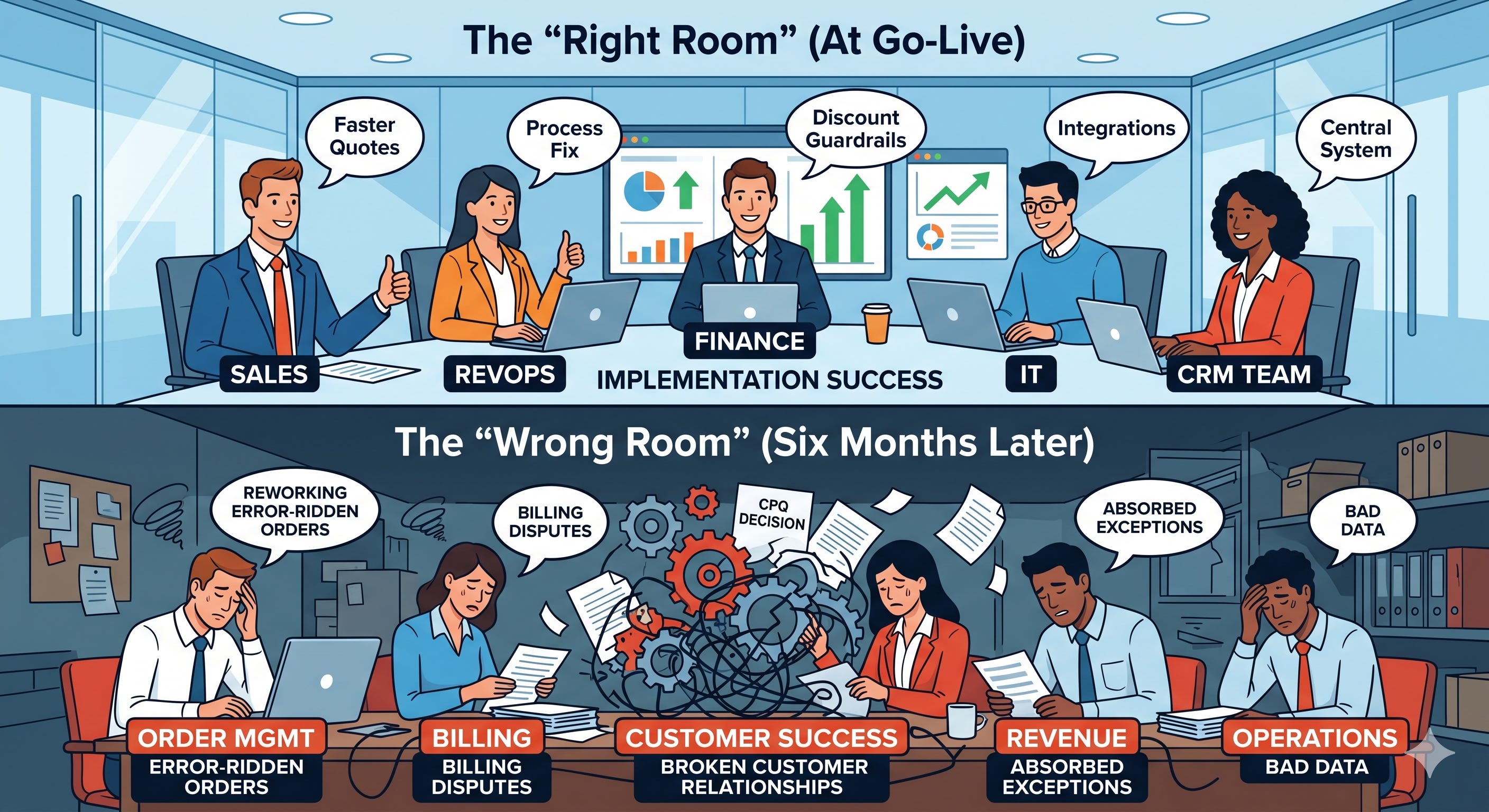
Sales says the reps need faster quotes. RevOps says the process is broken. Finance wants guardrails on discounting. IT asks about integrations. The CRM team wants to make sure their system stays central.
It’s a reasonable room. It’s also the wrong room.
The people who actually live with a bad CPQ decision — the ones who rework the orders, absorb the exceptions, resolve the billing disputes, and rebuild the customer relationships — are almost never invited to the table.
That asymmetry is why so many CPQ implementations look like a success at go-live and a problem six months later.
Who’s Not in the Room — and Why It Matters
Walk through what actually happens after a quote becomes an order.
Order Management inherits whatever the quote said. If the configuration was sloppy or the line items don’t map cleanly to fulfillable SKUs, they’re the ones translating a commercial promise into something a warehouse or a vendor can actually act on.
Billing and Invoicing triggers off the order. If the discounting structure was non-standard, if a bundle wasn’t decomposed correctly, or if the contract terms were captured in a PDF instead of a structured field — the invoice is wrong. The dispute follows.
Field Service shows up at the customer site with whatever the work order says. If the CPQ didn’t generate a proper service requirement, the technician either doesn’t have the right parts, or the system doesn’t know the asset exists yet.
Customer Service fields the calls when any of the above goes sideways. They’re resolving the downstream damage from a quote that was fast but wrong.
Contract Operations manages the renewal baseline. If the original quote didn’t capture the right entitlements, the right terms, or the right asset relationships, the renewal conversation starts from a broken foundation.
None of these teams chose the CPQ. None of them were in the room. All of them pay the price.
The Quote Is an Operational Promise — Not a Sales Document
Here’s the framing that should reorient every CPQ decision:
The quote is the first operational promise a company makes to a customer.
Not a sales artifact. Not a pricing document. A promise — to deliver something specific, at a specific price, under specific terms, in a specific timeframe. Every team downstream of that promise is responsible for keeping it.
That means the scope of a CPQ decision is not “how do we get quotes out faster.” The scope is: how do we make sure the quote creates an order we can fulfill, invoice correctly, service properly, asset-track accurately, and renew from a clean baseline.
“Quote-to-cash” undersells this. The quote becomes an order, a delivery plan, a field service requirement, an asset record, a warranty obligation, a billing trigger, a renewal baseline, and a margin commitment. That’s not a sales process. That’s the entire operating model of a complex business.
Why CRM Isn’t the Right Center of Gravity Here
This is where a lot of CPQ conversations go sideways.
CRM is the right system for relationship management and pipeline tracking. It’s the right system for logging activity, forecasting, and managing the customer record. Nobody is arguing that.
But when the commercial process gets complex — when you’re configuring multi-product bundles, managing approval chains, decomposing orders into fulfillment components, creating assets, triggering service obligations, and setting the terms for future renewals — you’re no longer doing relationship management.
You’re doing workflow execution.
That’s a different system requirement. And it’s why ServiceNow CPQ changes the conversation.
ServiceNow CPQ doesn’t sit alongside the downstream workflows. It sits *inside* them. CSM, FSM, SOM, asset management, entitlements, billing — these are native to the platform. When a quote becomes an order on ServiceNow, the downstream isn’t an integration problem. It’s a configuration.
The center of gravity for complex commercial processes doesn’t belong in the CRM. It belongs where the execution happens.
What Mountain Point Does Differently
Most CPQ implementations are designed by the same people who wrote the original problem statement: Sales and RevOps, with IT along for the ride.
We bring in the downstream stakeholders early — before the solution is scoped, before the data model is locked, before the integration decisions are made.
Not because we want a longer discovery process. Because the people who absorb the operational risk of a bad quote are the people who can tell you exactly where the current system fails.
Field Service knows which order types always create rework. Billing knows which discount structures always generate disputes. Order Management knows which product configurations never fulfill cleanly. That’s the intelligence that shapes a good CPQ implementation.
When those voices are in the room at the start, the solution is built for the whole promise — not just the moment of sale.
The Real Win
Faster quotes are good.
Fulfillable, profitable, serviceable quotes are the real win.
If your CPQ evaluation is only measuring quote velocity and CRM integration, you’re measuring the wrong things. The right questions are: What happens when this quote becomes an order? Who touches it, what do they need, and where does it break today?
The teams who can answer those questions aren’t usually in the buying room. They should be.