

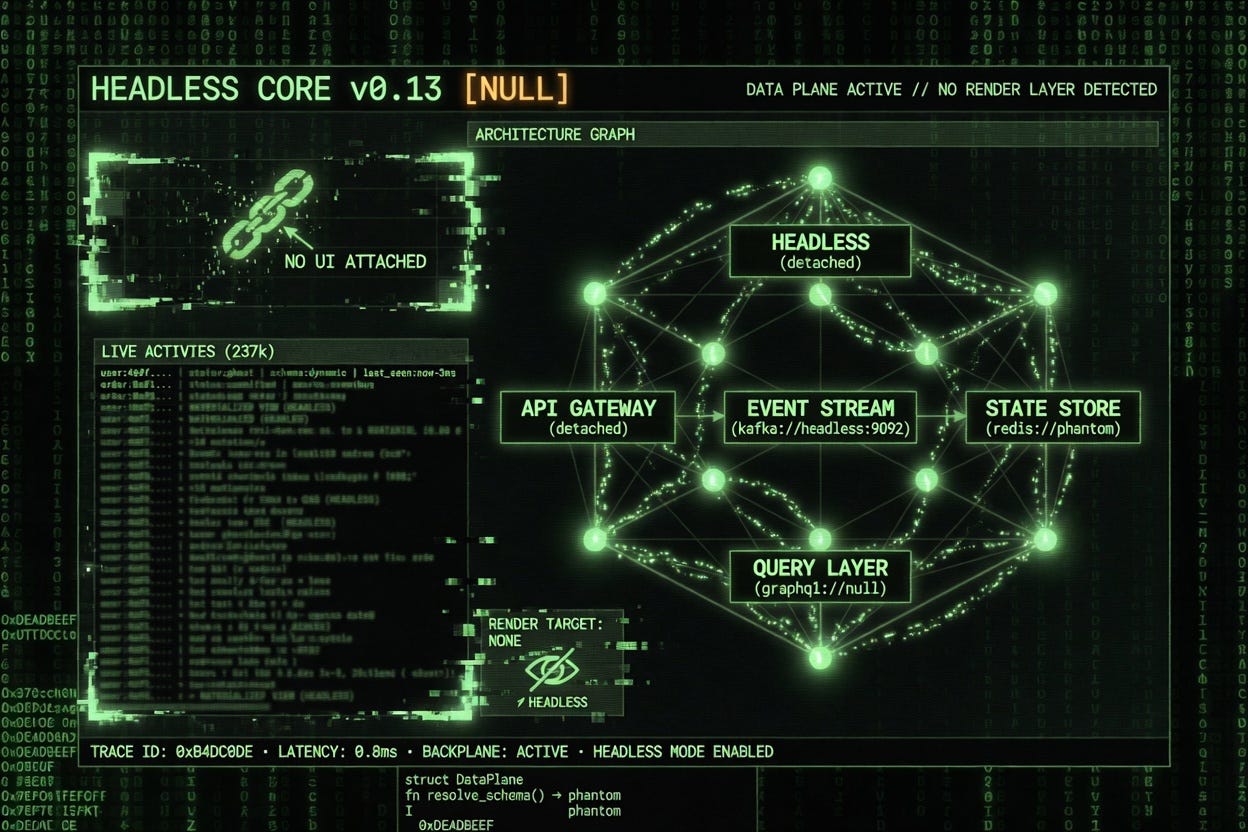
Last week, Salesforce stood on stage at their TDX developer conference and announced something they called Headless 360. The headline: Salesforce is stripping out the interface. No more dashboards to log into. No more screens to navigate. Every capability in the platform — CRM, service, marketing, commerce — exposed as an API, an MCP tool, or a CLI command. Built so AI agents can access it directly, without a human ever opening a browser.
Marc Benioff called it the most ambitious architectural shift in 27 years.
It’s easy to read that as a developer announcement. A technical footnote for the Salesforce architect crowd.
It’s not. It’s a signal about where all of enterprise software is heading — and for anyone in the CPQ and revenue operations world, there’s an important footnote: the best configuration engine in the space built this way from day one.
What “Headless” Actually Means
The word comes from web architecture. A “headless” system is one where the back-end logic — the data, the rules, the processing — is completely separated from the front-end presentation layer. The “head” is the interface humans look at. Remove it, and what’s left is pure capability: something that does work, responds to inputs, and produces outputs, without requiring a human to navigate it.
For years, headless was mostly a concept for e-commerce platforms. Your product catalog, inventory, and checkout logic running in the back-end, delivered to whatever front-end made sense — a mobile app, a kiosk, a partner portal, a voice assistant.
But the idea is now spreading to every layer of enterprise software. And the reason is agents.
When a human uses software, they need an interface. They need screens, menus, buttons, forms. That’s the entire history of enterprise software design — build a UI that a person can navigate.
When an agent uses software, it doesn’t need any of that. It needs an API. It needs a way to say: get this record, update that field, trigger this workflow, return that result. The interface is overhead. The interface is, in a very real sense, the thing slowing everything down.
Headless architecture is what happens when you design for agents instead of humans.
CPQ Already Knew This
Here’s the thing that doesn’t get said enough in the broader “agentic future” conversation: the CPQ world has been living this problem for years.
Traditional CPQ platforms — including Salesforce CPQ, which is now end-of-sale — were built as managed packages inside CRM. The configuration logic and the quoting interface were tightly coupled. You couldn’t run one without the other. Every customization added code and complexity. Scaling meant adding overhead. And if you wanted to power a partner portal, an e-commerce channel, or a self-service configurator alongside your sales team’s workflow, you were essentially rebuilding the logic from scratch for each surface.
That’s the headed problem. The engine and the interface are glued together. You can’t get to the engine without going through the screen.
Logik was built to solve exactly this. The configuration engine — the logic that validates product rules, enforces dependencies, calculates pricing — sits completely separate from any front-end presentation. You call it via API. It returns a result. It doesn’t care whether a sales rep is on the other end, or a partner portal, or an e-commerce checkout, or — and this is the part that matters now — an AI agent.
That’s why ServiceNow’s acquisition of Logik wasn’t just a CPQ deal. It was an architecture bet. ServiceNow looked at where enterprise software was heading and recognized that a headless configuration engine — one that could power any channel, any workflow, any interface — was foundational infrastructure for an agentic world.
When an AI agent needs to validate whether a product configuration is valid, check pricing against contract terms, and generate a quote without a human navigating through screens, it needs exactly what Logik was designed to provide: a clean API that returns accurate answers fast.
The Implications Are Bigger Than They Sound
Here’s the shift that manufacturers need to internalize: your enterprise software is about to have two kinds of users — humans and agents — and they need completely different things.
Humans need interfaces. Dashboards, exception queues, approval screens, reports. The UI isn’t going away for people.
Agents need APIs. Clean, documented, reliable programmatic access to the capabilities inside your systems. They don’t care what the screen looks like. They care whether they can read a customer record, validate a configuration, check pricing, and push an order — without waiting for a human to click through five screens to do it.
Right now, most manufacturers’ systems are built entirely around the human experience. Every workflow assumes a person is driving. Every process has a screen attached to it. Every approval requires someone to log in, review, and click a button.
That design assumption is about to become a constraint.
If your systems can’t be accessed headlessly — if there’s no clean API layer underneath your CPQ, your ERP, your CRM — then agents can’t work with them autonomously. They’ll need a human in the loop for every step. Not because the human adds judgment value, but because the system requires a human to drive the interface.
That’s not a people problem. That’s an architecture problem.
What This Looks Like in Your Revenue Motion
Think about your quote-to-cash process for a moment.
A deal closes. Someone logs into Salesforce to mark it won. Someone else pulls the quote details, validates the configuration, checks pricing against the contract, routes for approval, creates the order in ERP, and confirms delivery terms with the customer.
Each one of those steps has a screen attached to it. A human navigates to the right place, enters or reviews the right data, and moves the process forward.
Now imagine that same process in a headless, agent-native architecture.
The deal closes. An agent reads the closed-won signal, calls the configuration engine to validate the product setup, checks pricing rules programmatically, routes the one approval that requires genuine human judgment, receives it, creates the order in ERP, and triggers the customer confirmation — without anyone logging in, navigating menus, or clicking through screens.
The human didn’t disappear. They made one decision, on one exception, where their judgment actually mattered.
Every other step was intelligence work. Rules-based. Automatable. Headless.
The outcome — a clean, accurate order flowing through to fulfillment — happened faster, with fewer errors, and without burning your best ops people on screen navigation.
That’s the outcome you’re actually trying to buy. The UI was always just the means of getting there.
The Design Bifurcation
In a world of headless architecture and autonomous agents, design splits into two fundamentally different problems.
Human-facing design is what most of us have always thought about: the dashboards your sales managers review, the exception queues your ops team works, the approval screens where real judgment gets exercised. These still need to be excellent. Clear, fast, actionable. Humans spending time in these interfaces should be spending it on decisions, not navigation.
Agent-facing design is new territory for most organizations. It’s about the API contract: what data is exposed, how it’s structured, what actions are available programmatically, how errors are handled, what guardrails are in place. This is the layer that determines whether an agent can do its job reliably — or whether it gets stuck waiting for a human to intervene on something that shouldn’t require one.
Most organizations have invested almost entirely in human-facing design. The screens look reasonable. The dashboards exist. But the agent-facing layer — clean APIs, documented capabilities, reliable programmatic access to the actual logic — is an afterthought, if it exists at all.
That imbalance is about to become a competitive problem.
ServiceNow CPQ, powered by the Logik engine, is one of the few CPQ platforms on the market where that agent-facing layer was part of the original design intent. The configuration engine was always meant to be called by anything. That’s not a lucky accident — it’s an architecture philosophy that turns out to be exactly right for where enterprise software is heading.
What Manufacturers Should Be Asking
You don’t need to rebuild your entire stack tomorrow. But if you’re doing any systems work in the next 12-18 months — a CPQ implementation, an ERP integration, a Salesforce or ServiceNow build — these questions are worth asking:
Can this system be accessed without a human navigating it? Not “does it have an API” in theory, but: is that API actually documented, maintained, and built to carry real workloads programmatically?
Where are humans currently required in my process — and is it because they add judgment, or because the system requires them? The distinction matters. One is a feature. The other is a bottleneck waiting to be engineered away.
When we configure this system, are we designing for today’s human users, or for the agents that will be working alongside them in two years? A workflow built entirely around a screen-based approval process is going to require rework. A workflow built around clean data states and programmatic triggers will scale in both directions.
The shift to headless architecture isn’t about removing humans from the picture. It’s about making sure humans are only in the picture where they belong — on the judgment decisions that actually require them.
Everything else is intelligence work. And intelligence work, increasingly, shouldn’t require a human to click a button to make it happen.
The Outcome Framing
This is why the outcomes conversation matters so much right now.
When you buy a tool — a CRM, a CPQ platform, an ERP — you’re buying the interface. You’re buying the screens. And then you spend months building workflows that assume humans will navigate those screens to get work done.
When you buy an outcome — quotes generated accurately, orders flowing cleanly, revenue recognized on time — the architecture has to support both human and agent users from the start. The headless layer isn’t an add-on. It’s a design requirement.
Salesforce’s Headless 360 announcement is significant not because Salesforce invented this idea, but because they’re signaling to the entire enterprise software market that agent-first architecture is the direction everything is heading. Logik figured this out years ago. ServiceNow made a $500M bet on it. The platforms that don’t build this layer will become bottlenecks. The businesses that don’t design for it will be stuck with humans doing jobs that systems should handle.
The UI was never the point. The outcome was always the point.
We just needed the rest of the market to catch up to what the best architecture already knew.
Mountain Point is one of a handful of partners with deep ServiceNow CPQ and Salesforce ARM implementation expertise. If you’re evaluating your CPQ architecture — or wondering whether your current setup is ready for an agentic world — that’s exactly the conversation we’re built for.