

For a long time, manufacturers treated the first sales conversation as the beginning of the buying process.
A customer submits a form.
A salesperson follows up.
Discovery begins.
Requirements are gathered.
Engineering gets involved.
A quote is eventually produced.
That process may still be familiar, but it no longer reflects how buyers actually behave.
By the time a customer talks to sales, they have usually already done their homework. They have researched options, compared vendors, reviewed available content, and formed an early opinion about who can help them.
The sale does not start when the salesperson gets involved.
It starts when the customer begins trying to solve the problem.
For engineer-to-order manufacturers, that shift matters.
The Buyer Is Already Moving
Customers do not want to wait for a sales call to learn what is possible.
They want to explore.
They want to understand tradeoffs.
They want to see whether a solution fits their application.
They want to know if the product can be configured around their constraints.
They want some level of confidence before they spend time with your team.
This does not mean they expect complex products to be simple. It means they expect the buying experience to be helpful earlier.
A PDF catalog, a generic contact form, and a promise that someone will get back to them is not enough anymore.
That may capture a lead.
It does not create momentum.
Your Website Is Part of the Revenue Process
For complex manufacturers, the website used to be treated mostly as a marketing asset.
It explained what the company did.
It listed products.
It showed industries served.
It gave customers a way to request information.
That role is changing.
The website is becoming the front door to the revenue process.
If a customer can answer guided questions, visualize a solution, configure around their requirements, generate preliminary drawings, review performance information, and see budgetary pricing, they are not just browsing.
They are entering the buying process.
That changes the purpose of digital experience.
It is no longer only about awareness.
It is about helping the customer make progress.
Self-Service Creates Better Sales Conversations
Self-service is often misunderstood.
It is not about removing salespeople or engineers from the process.
It is about making the first human conversation more valuable.
When a customer can explore options before engaging your team, they arrive with better context.
They know what they are trying to solve.
They have seen potential solutions.
They understand some of the tradeoffs.
They may already have preliminary drawings or a rough configuration.
That means sales and engineering do not start from zero.
They can refine.
Challenge assumptions.
Solve edge cases.
Confirm feasibility.
Help the customer make a better decision.
The conversation becomes less about collecting information and more about applying expertise.
That is a better experience for everyone.
Visual Configuration Builds Confidence
In engineer-to-order environments, customers often struggle to translate requirements into a product concept.
They may know the problem they need to solve, but not the specific configuration, dimensions, options, or constraints that matter.
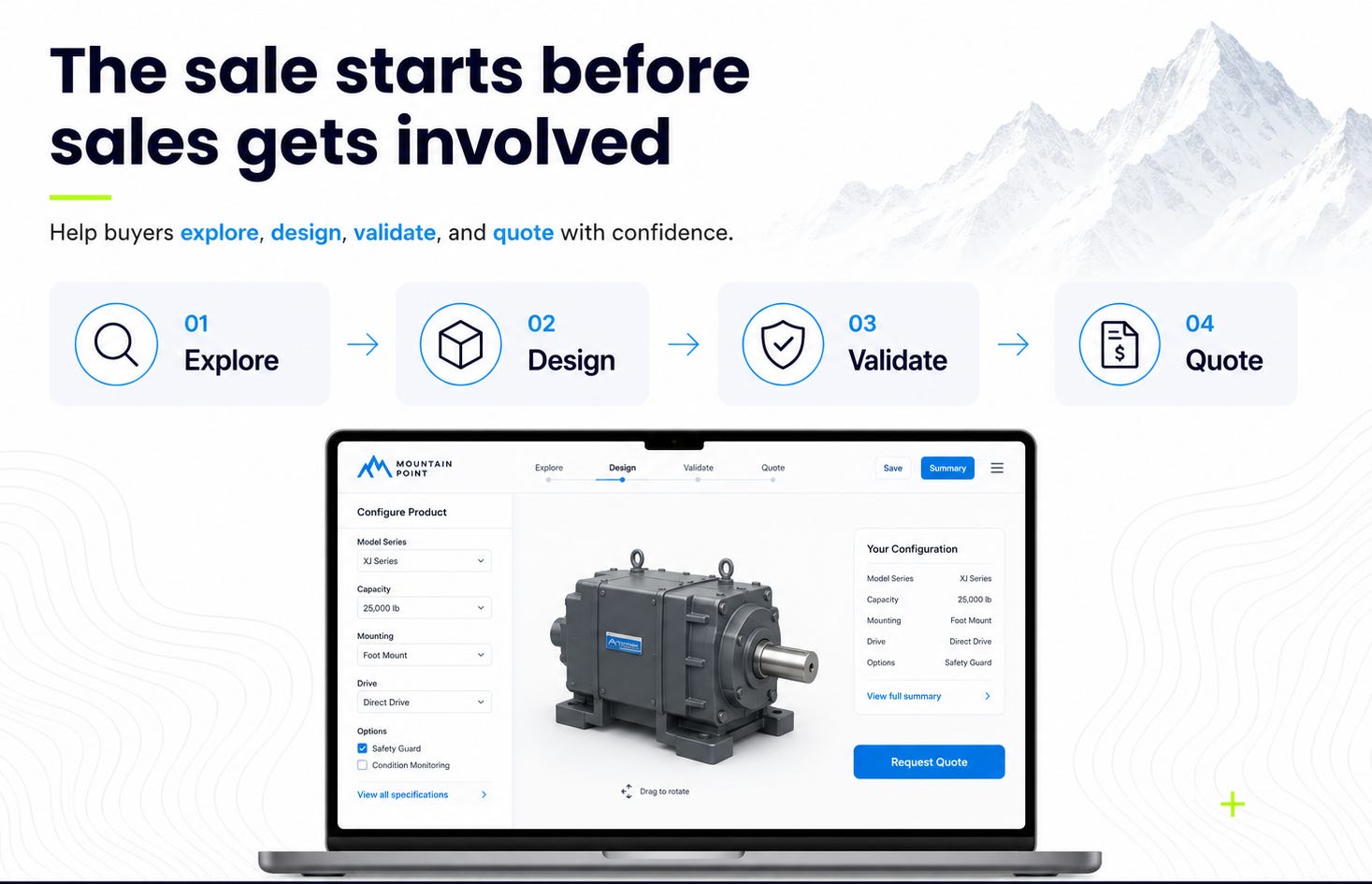
Visual configuration changes that.
Instead of forcing the customer to interpret tables, part numbers, and technical documents, it lets them see the solution take shape.
As they answer questions, the model updates.
As dimensions change, drawings adjust.
As options are selected, rules validate what is possible.
As the design evolves, pricing and lead-time expectations can update with it.
This creates confidence before the quote is finalized.
It also improves the quality of the opportunity.
The customer is not just asking for information. They are actively designing a solution with you.
The Best Leads Are Educated Leads
Manufacturers often think about lead generation in terms of volume.
More form fills.
More inquiries.
More contacts.
But volume is not the goal. Quality is.
A customer who has already explored a configuration, reviewed drawings, understood tradeoffs, and seen budgetary pricing is a very different opportunity than someone who simply downloaded a brochure.
They are more informed.
They are more engaged.
They are more likely to understand value.
They are also more likely to have internal alignment because they can share something tangible with their own stakeholders.
That is where self-service becomes more than convenience.
It becomes a way to improve the entire revenue process.
The Handoff Still Matters
The goal is not to let the customer do everything alone.
In complex manufacturing, the handoff to sales, engineering, operations, and fulfillment still matters.
But the handoff should be cleaner.
If a customer has already created a preliminary design, the handoff should preserve that context.
Sales should see what the customer configured.
Engineering should see the assumptions, constraints, and selected options.
Operations should understand what may eventually need to be built.
Finance should understand the pricing logic.
Service should eventually know what was promised.
That is why the buying experience cannot be disconnected from CRM, CPQ, order management, ERP, and service.
The front-end experience creates the first version of the customer’s intent.
The rest of the revenue process should carry that intent forward without losing it.
The Takeaway
The next wave of growth for complex manufacturers will not come only from better products or more aggressive sales outreach.
It will come from making it easier for customers to move forward.
Customers want to explore before they talk.
They want to design before they commit.
They want to validate before they wait.
They want confidence before they raise their hand.
The companies that understand this will treat self-service, visual configuration, drawings, pricing, and quoting as more than digital tools.
They will treat them as the beginning of the revenue process.
Because the sale does not start with a call.
It starts with a customer experience that makes the buyer believe they are already on the right path.