

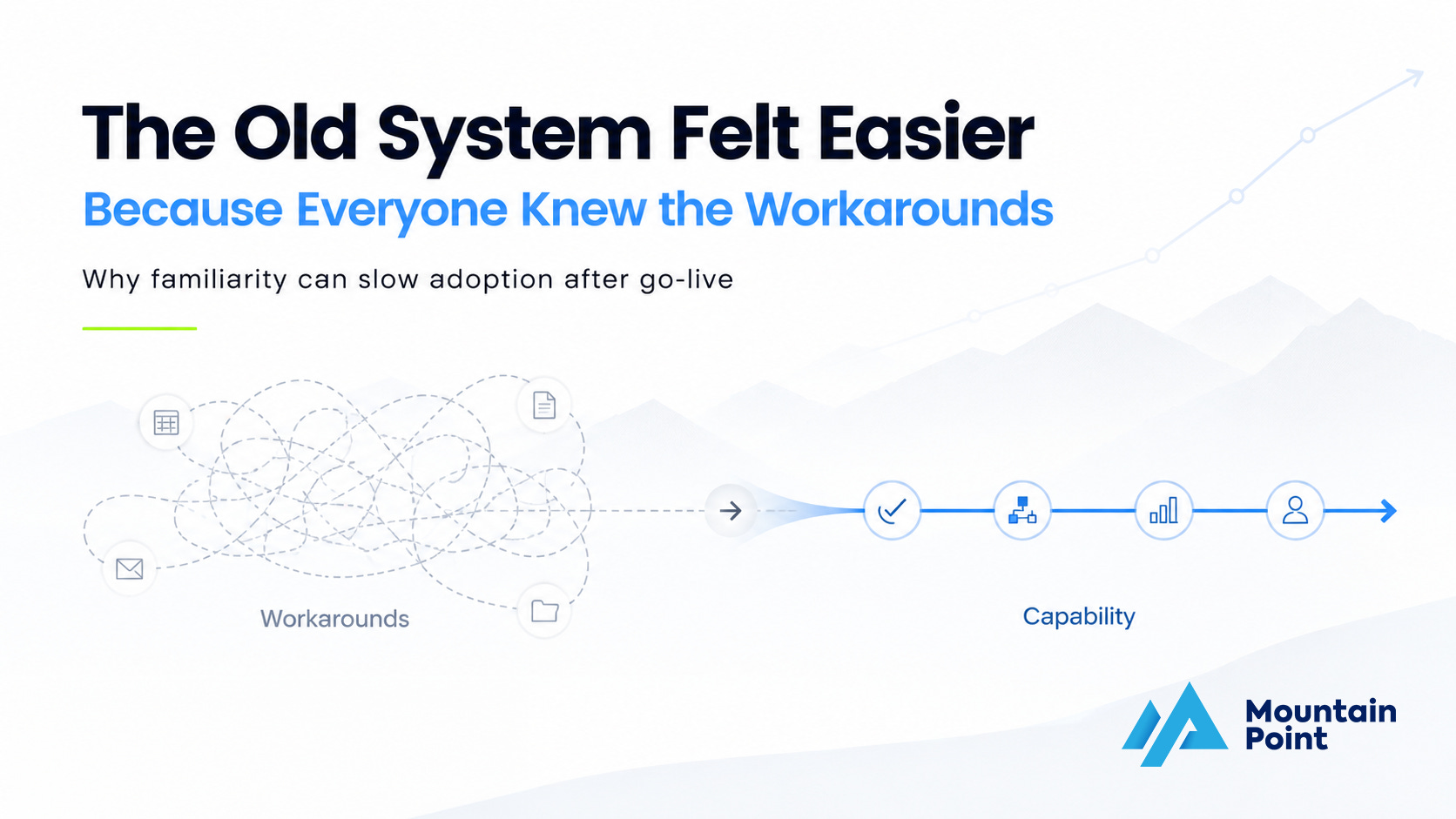
One of the hardest parts of transformation is separating what users feel from what is actually happening.
A new CRM, CPQ, ERP workflow, portal, or AI-enabled process goes live. The business case was clear: the old process was too manual, too dependent on spreadsheets, too hard to report on, and too reliant on a few people who knew how everything really worked.
Then users start reacting.
“The old system was easier.”
Sometimes they are right. The new system may have real friction that needs to be fixed. But often, that statement means something else:
The old system was familiar.
Users knew the shortcuts. They knew which fields could be skipped. They knew who to message when something got stuck. They knew which spreadsheet corrected bad data. They knew how to get the work done around the system.
That does not mean the old system was better.
It means the business had adapted to its limitations.
Familiar Is Not the Same as Effective
Old systems often feel faster because people have built muscle memory around them.
The new system feels slower because it forces people to think again.
It may require cleaner data.
It may ask for decisions earlier.
It may enforce approval logic.
It may expose handoffs that used to happen informally.
It may require teams to stop relying on tribal knowledge and put more of the process into the workflow.
That can feel like friction, but sometimes friction is just structure showing up.
If CPQ requires better product data, that is not unnecessary complexity. It is what allows the quote to be accurate.
If approvals happen earlier, that may not be bureaucracy. It may be margin protection.
If customer or order information has to be captured upfront, that may not be extra work. It may be what prevents cleanup later.
The user feels the new step.
The business needs to understand the downstream value of that step.
Workarounds Hide the Real Cost
Every legacy process has workarounds.
A spreadsheet outside the system.
An approval in email.
A manual order review before ERP.
A finance correction after the quote.
A salesperson who knows which fields “really matter.”
Over time, these workarounds become invisible. They feel normal because everyone knows how to use them.
That is the problem.
The old system can feel easy because the real work is happening somewhere else.
The new system feels hard because it brings that hidden work into the open.
This is why early user feedback matters, but it has to be interpreted carefully.
A complaint may point to bad design.
It may point to poor training.
It may point to a workflow that needs refinement.
Or it may point to an old habit the business needs to retire.
Those are very different problems.
Adoption Is a Mental Model Shift
Adoption is not just teaching people where to click.
It is helping them understand why the work changed.
Why is the data required?
Why does the approval happen here?
Why does the quote need to be structured differently?
Why does the system prevent a shortcut that used to be common?
If users do not understand the reason behind the workflow, they will compare the new system to the old workaround.
And the workaround will usually feel easier.
That is how companies end up with modern platforms and legacy behavior.
The technology changes.
The operating model does not.
Strategic Enablement Closes the Gap
This is where Strategic Enablement Services matter.
After go-live, companies need more than support tickets and training sessions. They need a rhythm for closing the gap between system design and user reality.
That means:
listening to user feedback
identifying real friction
refining workflows
reinforcing the new process
retiring old workarounds
tracking adoption
connecting improvements back to business outcomes
Support fixes what is broken.
Enablement helps determine what needs to change.
A ticket can fix a field.
Enablement asks whether the field is needed, whether users understand it, and whether it supports the outcome the business wants.
That is the difference.
The Goal Is Not to Recreate the Old System
When users struggle, the easy response is to make the new system feel more like the old one.
Sometimes that is appropriate. Good feedback should improve the experience.
But if the new platform simply recreates the old process, the transformation loses its purpose.
The goal is not comfort.
The goal is capability.
Can the business quote faster and more accurately?
Can teams trust the data?
Can approvals happen with better context?
Can operations receive cleaner orders?
Can leaders see what is happening?
Can automation and AI work because the process is structured enough to trust?
Those are the measures that matter.
The Takeaway
The old system often felt easier because everyone knew the workarounds.
That does not mean it was better.
It means the business had learned how to operate around its problems.
Modern systems expose those problems. They require cleaner data, clearer rules, better handoffs, and more shared accountability. That can feel uncomfortable at first.
But discomfort is not always a sign the system is wrong.
Sometimes it is a sign the business is finally changing.
The companies that get value from transformation are the ones that manage the perception gap. They listen to users, fix real friction, reinforce the new way of working, and retire the workarounds that no longer serve the business.
That is how adoption becomes capability.