

Technical teams are moving faster than ever.
AI can now write code, refactor it, generate tests, explain errors, review pull requests, and suggest architectural patterns in minutes. For a lot of teams, that has already changed the pace of delivery.
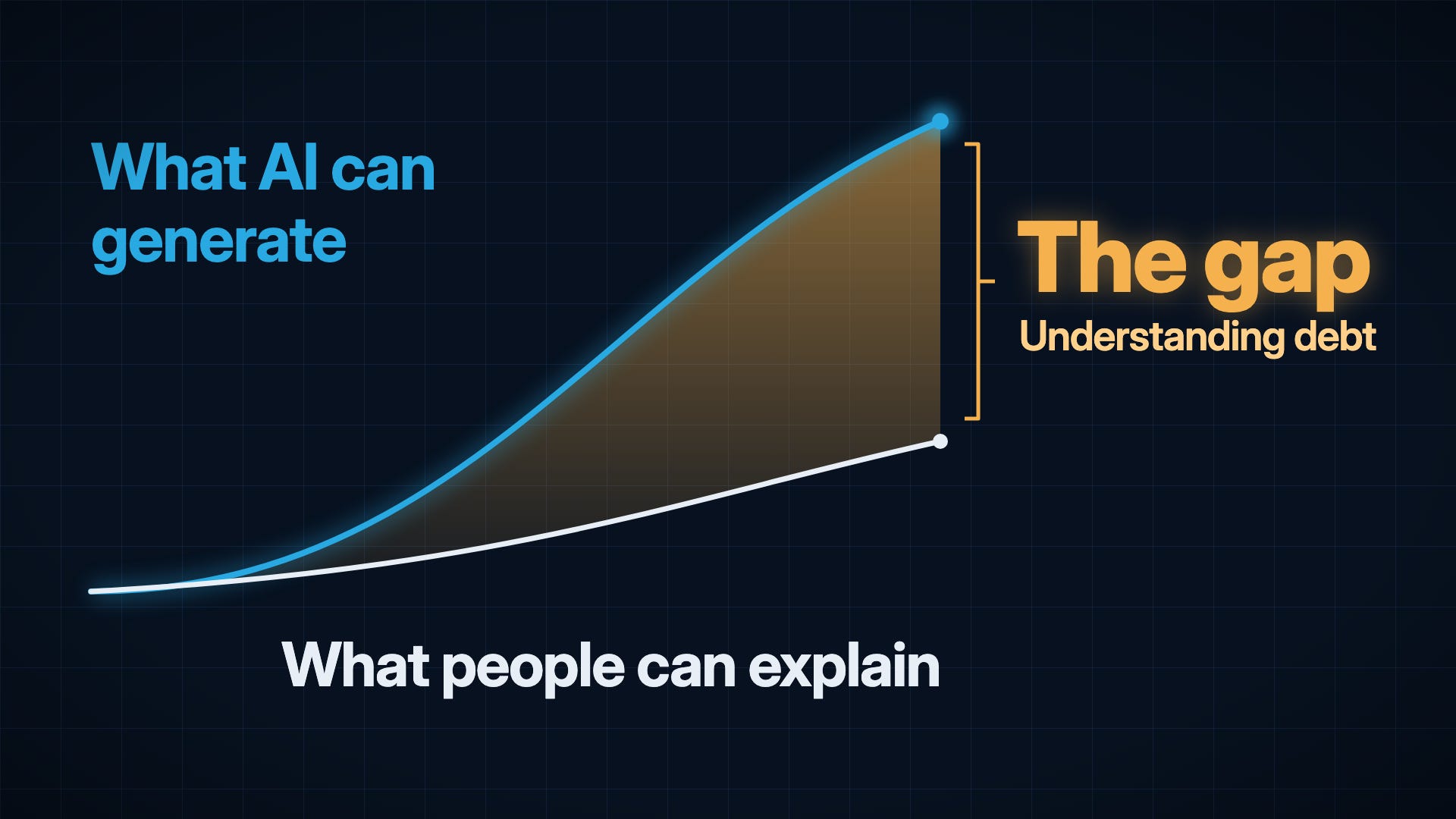
The problem is that human understanding is not accelerating at the same rate.
That is where I think a new kind of technical debt is starting to show up: understanding debt.
Traditional technical debt is usually about shortcuts in the code or workarounds to just get something to work that accumulate over time. You ship something that works, knowing the implementation may need to be cleaned up later.
Understanding debt is different. The code may be clean. The tests may pass. The pull request may look fine.
But fewer people actually understand what was built, why it was built that way, which assumptions are buried inside it, and what will happen when something changes.
That is a very different kind of risk.
The easy button is getting easier
It is hard to fault technical teams for leaning into AI. The productivity gains are real.
A developer gets stuck on an integration. Instead of digging through documentation for an hour, they ask an AI assistant. A junior engineer needs a first pass at an API. AI generates it. A team needs unit tests, migration logic, a data transformation, or a workflow update. AI can produce a working version almost immediately.
That is useful.
The problem starts when the speed of generation begins to outrun the speed of comprehension.
A developer can now create more code in an afternoon than they may have previously written in several days. The review burden does not disappear. If anything, it increases.
You still need to know whether the solution fits the architecture, whether the tests cover the right behavior, whether the code is secure, whether the data model makes sense, and whether someone else can maintain it six months from now.
The bottleneck is moving from writing the code to understanding the code.
Assisted, created, and validated are not the same thing
I think technical teams also need to be more explicit about how AI is being used.
There is a meaningful difference between AI-assisted, AI-created, and AI-validated work.
AI-assisted work is still primarily human-owned. The engineer understands the solution and uses AI to move faster through parts of the implementation.
AI-created work shifts more of the implementation to the model. The human defines the outcome, reviews the result, and decides whether it is acceptable.
AI-validated work goes another step further. AI writes the code, AI writes or updates the tests, AI reviews the change, and the human increasingly becomes the person approving a result that was generated and checked by systems they did not fully control.
That last model is where things get uncomfortable.
A green pipeline can create a false sense of confidence when nobody on the team has a strong mental model of what actually changed.
Human in the loop is not enough
We use “human in the loop” as a reassuring phrase, but the quality of that human involvement matters.
A human clicking Approve on an AI-generated pull request is technically in the loop.
That does not mean they understand the work.
The better standard is human ownership.
The person responsible for shipping the change should still be able to explain what problem is being solved, why this approach was chosen, what assumptions it makes, what could fail, how the team would detect that failure, and what another engineer would need to know to maintain it later.
If those answers are unclear, the team may already be accumulating understanding debt.
The risk is bigger than custom code
This is not just a software development problem.
The same pattern is starting to show up in configuration-heavy platforms, integrations, workflow automation, and low-code environments.
AI can increasingly create Salesforce flows, ServiceNow workflows, integration logic, formulas, configuration rules, test scripts, and deployment artifacts.
That creates the same temptation: describe the outcome, accept the generated solution, and move on.
But enterprise systems tend to live for years. The person who approves the generated logic today may not be the person troubleshooting it later.
The more business-critical the system, the more dangerous it becomes to ship changes that work but are not well understood.
The answer is not to slow down
The goal should not be to make teams use less AI.
That would miss the point.
The better approach is to decide where speed matters most and where human understanding remains non-negotiable.
AI should absolutely accelerate repetitive work, boilerplate, test generation, documentation, refactoring, exploration, and first-pass solutions.
Human understanding should remain strongest around architecture, security, data models, integration contracts, business rules, destructive changes, and production releases.
The line will be different for every team, but there needs to be a line.
Otherwise, organizations risk getting faster at creating systems they understand less.
Technical leadership is changing
There is also a bigger implication for technical roles.
The most valuable skill may become less about how quickly someone can write the code and more about how well they can evaluate what should exist in the first place.
Can they identify the right architecture?
Can they understand the business rule behind the request?
Can they challenge an AI-generated solution instead of assuming it is correct?
Can they recognize when the output is technically valid but wrong for the business?
Those skills become more important as AI gets better at implementation.
The engineer who understands the system may become more valuable than the engineer who can simply produce the most code.
Understanding debt compounds too
Traditional technical debt eventually slows teams down.
Understanding debt will do the same thing.
The first few AI-generated changes may feel like pure productivity. Over time, though, teams can accumulate layers of logic that nobody fully owns, tests that validate assumptions nobody remembers making, and workflows that become increasingly difficult to change without asking AI to explain the last thing AI created.
That is not a sustainable operating model.
The goal should be to use AI to increase the leverage of technical teams without allowing the team’s understanding of the system to fall behind the system itself.
AI is making it easier than ever to ship.
The harder discipline now is making sure we still understand what we are shipping.
Keeping AI acceleration from becoming understanding debt
At Mountain Point, we spend a lot of time helping companies modernize CRM, CPQ, integrations, and workflow-heavy platforms where the long-term architecture matters as much as the initial implementation.
As AI becomes a bigger part of how that work is created, reviewed, and maintained, the same principle applies: move faster, but keep enough human ownership in the process that the business still understands what it is running.
Say an AI-generated workflow passes every test for a normal production run. What happens when a batch is put on hold halfway through? The engineer signing off needs to know which steps will stop and which will keep running.