

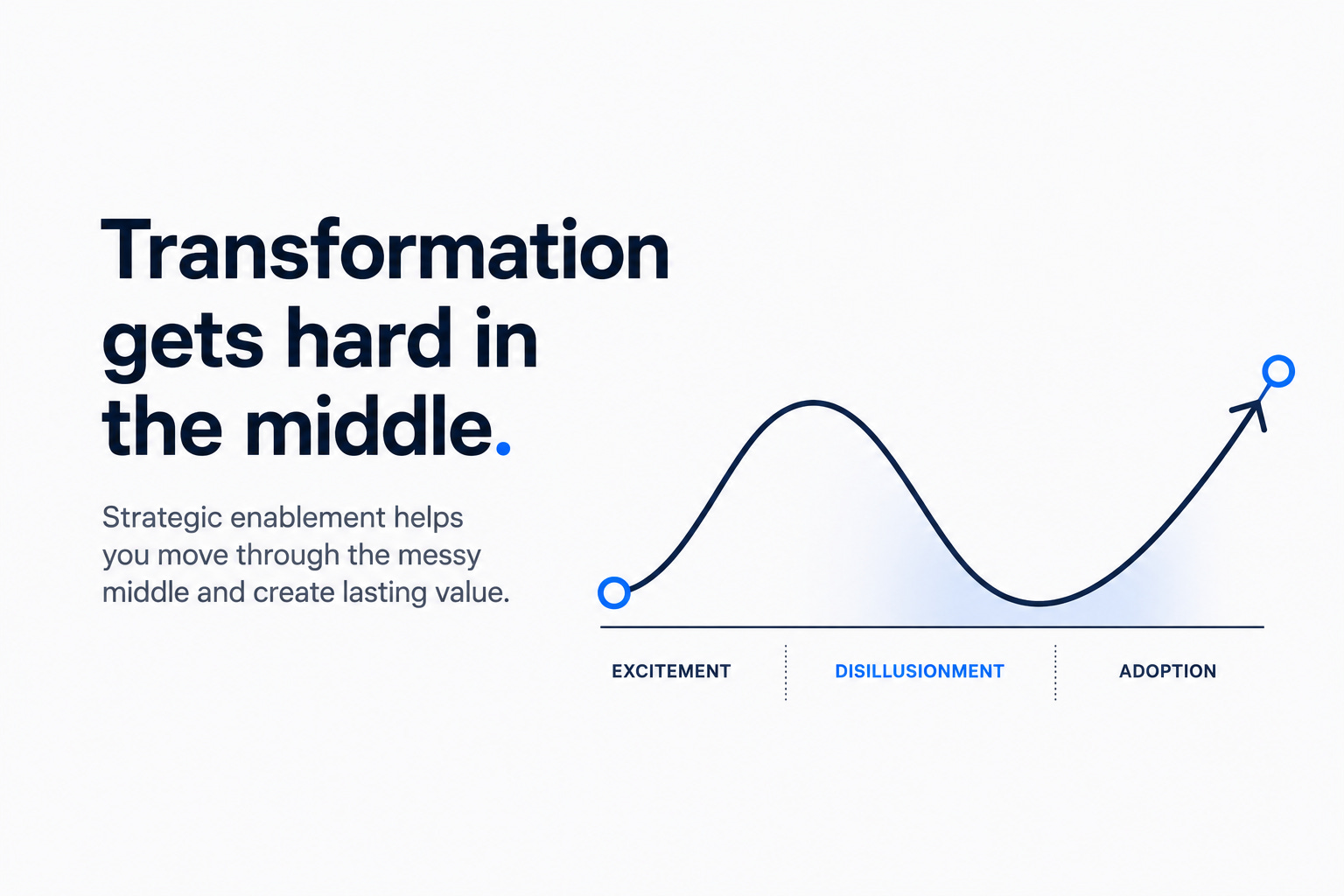
Most transformation work starts with too much confidence.
That is not a criticism. It is just how these things go.
The kickoff feels good. The business case makes sense. Everyone agrees the current process is too manual, too slow, too dependent on a few heroic people who know how everything really works. The first workshops uncover obvious opportunities. The demos looks promising. The prototype gets people excited.
Then the real work starts.
The data is worse than expected. The exception process has exceptions. The approval path that looked simple on a whiteboard turns out to depend on three people, two spreadsheets, and a Slack thread no one documented. Users like the idea, but they are busy. Leaders want speed, but every decision has tradeoffs. IT wants something secure and maintainable. The business wants something flexible. Sales wants fewer clicks. Finance wants more control. Operations wants fewer surprises.
This is the middle.
It is where a lot of transformation efforts either mature or quietly stall.
And it is exactly where Strategic Enablement Services create value.
Projects and Support Leave a Gap
Most companies still think about services in two buckets.
There is the project: define the scope, build the plan, hit the milestones, get to go-live.
Then there is support: fix issues, respond to requests, keep the system running.
Both matter. But neither one fully solves the problem companies are facing right now.
Projects are useful when the path is clear. The problem is that the path is often not as clear as everyone pretends it is at the beginning. You learn things as you build. Priorities shift. Users react differently than expected. AI capabilities change. The business sees the first version and immediately understands what it should have asked for.
Support is useful when something breaks. But support is usually reactive. It helps the system function. It does not necessarily help the business get better.
The real need sits between those two models.
Companies need a way to keep moving after the initial project energy fades, but before the new way of working has fully taken hold.
That is the enablement gap.
The Trough Is Not the Problem
The “trough of disillusionment” is usually talked about like it is a bad thing.
I don’t think that is always true.
The trough is often the first honest part of the transformation.
At the beginning, everything is theory. The process maps are clean. The future state looks obvious. The business case assumes a level of adoption and alignment that always feels reasonable in a deck.
Then people start using the thing.
That is when you find out what was missed.
The sales team still has a workaround. Engineering still does not trust the inputs. Finance still wants a review step that was supposed to be automated. Operations still has to clean up orders before they hit ERP. The dashboard is live, but nobody agrees what the numbers mean.
That can feel like failure.
Usually, it is just reality showing up.
The organizations that struggle are the ones that treat this moment as proof the project went wrong. The better move is to treat it as the moment where the next layer of work becomes visible.
What needs to be governed?
What needs to be simplified?
What needs more training?
What needs a better workflow?
What should be automated, and what still needs judgment?
What should be killed because it sounded good but is not actually useful?
Strategic enablement gives companies a structure for answering those questions without turning every lesson into a new project or every problem into a support ticket.
Teams Have to Storm Before They Perform
Tuckman’s model is simple for a reason: forming, storming, norming, performing.
It applies almost perfectly to transformation work.
In the forming stage, everyone is aligned because the conversation is still high-level. The goals are broad enough for everyone to agree.
Then the storming starts.
That is when the business has to make real decisions.
Who owns the process?
Who gets to approve exceptions?
What happens when sales wants speed and finance wants control?
What happens when the best customer experience creates more work for engineering?
What happens when AI can do something, but nobody is sure whether it should?
This is the part companies underestimate.
They assume friction means misalignment. Sometimes it does. But often friction means the operating model is finally becoming visible.
You are no longer talking about transformation as a concept. You are deciding how the business should actually work.
That is uncomfortable.
It is also necessary.
Strategic enablement helps teams move through that phase. Not by pretending every stakeholder wants the same thing, but by creating the rhythm to make decisions, test changes, capture feedback, and keep improving.
That is how teams get from storming to norming.
That is how a project becomes a capability.
AI Makes This More Urgent, Not Less
AI is speeding up the front end of transformation.
That is exciting. It is also creating a lot of false confidence.
A team can build a prototype in a few days. Someone can vibe-code a workflow that looks impressive by Friday. A demo can make an old process feel obsolete before anyone has dealt with permissions, governance, data quality, testing, support, or adoption.
This is the trap.
A prototype that works once is not the same as a capability the business can run.
A demo does not tell you who owns the process.
An agent does not automatically understand which exceptions matter.
A chatbot does not fix bad data.
A workflow built quickly does not automatically become secure, scalable, or maintainable.
AI makes it easier to create the first version. It does not remove the hard part of making that version trustworthy.
In some ways, AI makes Strategic Enablement more important because companies are going to create more experiments than ever. More pilots. More half-built workflows. More internal tools. More “this is almost ready” moments.
The question becomes: which of those should become part of how the business runs?
That is not just a technical question.
It is an operating model question.
Enablement Is Not Just Training
This is where the word “enablement” can get misunderstood.
A lot of people hear enablement and think training.
Training is part of it, but it is not the whole thing.
Strategic enablement is the ongoing work of turning technology into business capability.
That includes adoption, process refinement, roadmap management, governance, release planning, backlog prioritization, reporting, user feedback, and executive alignment.
It also includes asking uncomfortable questions after go-live.
Are people actually using the system?
Are they using it the way we intended?
Where are they working around it?
Which parts are creating value?
Which parts are slowing people down?
Which rules need to change?
Which reports are noise?
Which AI ideas are worth scaling?
Which ones are distractions?
That work does not fit neatly into a traditional implementation plan. It also should not be reduced to reactive support.
It needs ownership.
Go-Live Is Not the Moment of Value
Go-live matters. But it is not the moment value is created.
Value comes when the business starts working differently.
That is especially true in revenue operations.
CRM, CPQ, pricing, approvals, order management, ERP integrations, portals, service workflows, and AI capabilities are not static assets. They need to evolve as the business evolves.
Products change.
Pricing changes.
Sales motions change.
Customer expectations change.
AI capabilities change.
Internal teams change.
If the system does not keep up, it starts to drift. At first, the drift is small. A spreadsheet here. A manual approval there. A side process that “only happens for this one segment.” Then, over time, the system no longer represents how the business actually works.
That is how platforms decay.
Not all at once. Slowly.
Strategic enablement is how companies fight that drift.
The Services Model Has to Change
The old model was built around big projects and support tickets.
That is not enough for the market we are in now.
Companies need partners who can help them build, learn, adjust, govern, and improve at the same time. They need enough structure to keep moving, but enough flexibility to adapt when the business learns something new.
That is a different kind of relationship.
It is not just “implement this system.”
It is not just “fix this ticket.”
It is more like: help us keep turning this investment into measurable progress.
That is where Strategic Enablement Services fit.
They give companies a way to move through the messy middle without losing momentum.
The Takeaway
Most transformations do not fail because the original idea was bad.
They fail because no one planned for what happens after the excitement wears off.
The middle is where the real work shows up.
It is where teams storm.
Where prototypes either become trusted capabilities or die in the backlog.
Where AI experiments have to become governed workflows.
Where systems either evolve with the business or begin to decay.
That is where Strategic Enablement Services create value.
The companies that win in the age of AI will not be the ones that avoid the messy middle.
They will be the ones that build the operating rhythm to move through it.