

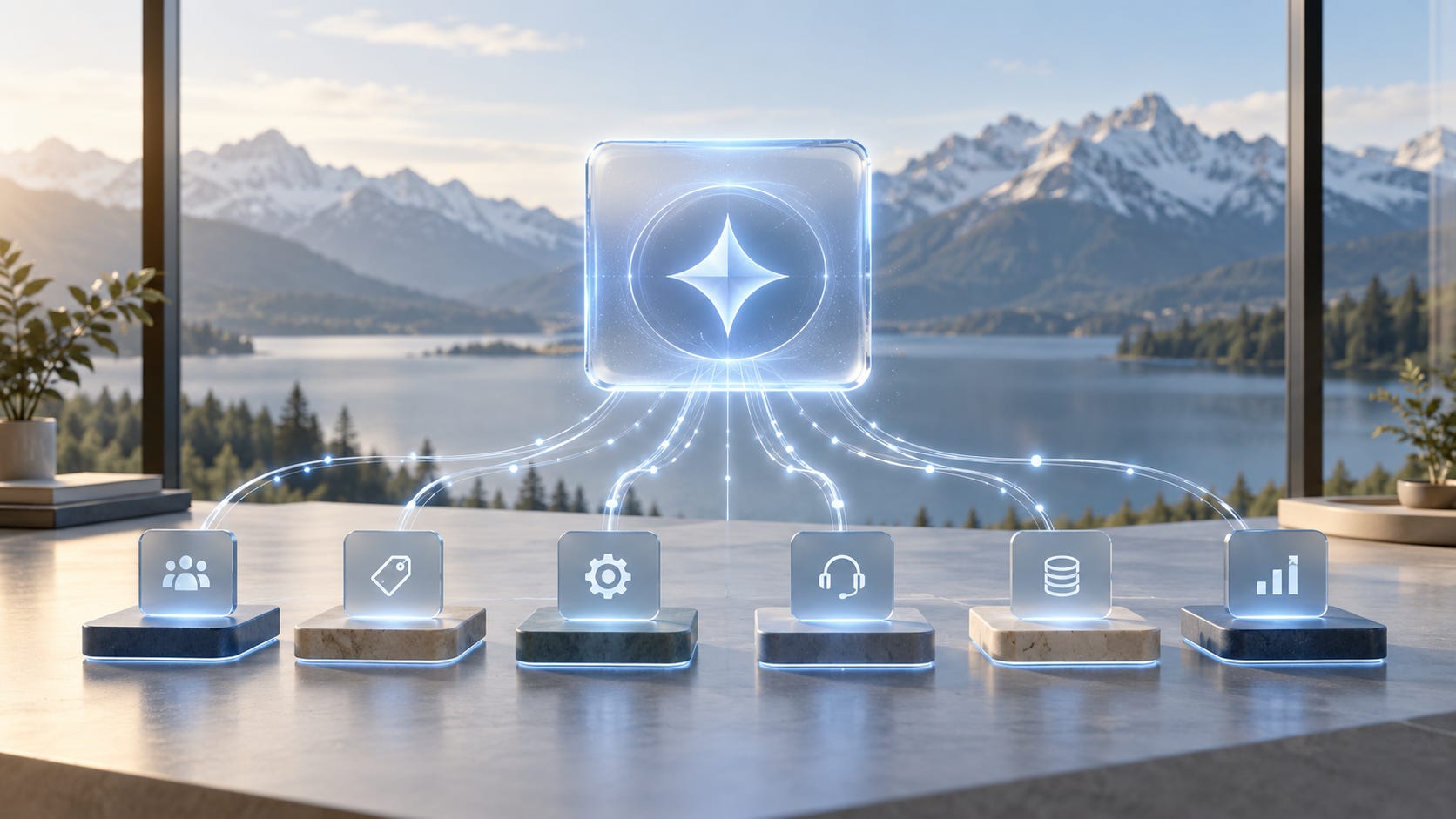
For years, CRM was positioned as the system of engagement. ERP was the system of record, finance had its own authoritative systems, and product, inventory, service, and operations each had platforms that owned their part of the business. CRM sat in front of all of them as the place where users engaged with customers and moved work forward.
That model is already changing. AI assistants and agents are becoming the new engagement layer, giving users a place to ask questions, make decisions, and trigger actions across CRM, ERP, CPQ, service, finance, and other systems without necessarily starting in any one of them.
The practical question for companies is no longer whether this shift is coming. It is how to keep up with it.
The front door has moved
A salesperson increasingly does not need to begin in CRM to get work done. They can ask an assistant to show them the opportunities that need attention, build a quote, check whether an order is blocked, pull service history, update a deal from meeting notes, or trigger the next step in a workflow.
The interaction is moving to the AI layer, while the systems underneath continue to hold the data, rules, and transactions.
The old model looked something like this:
User → CRM → other systems
The emerging model looks more like:
User → AI engagement layer → CRM + CPQ + Service + ERP + Finance
That is a meaningful architectural change because CRM remains important, but it is no longer automatically the place where the user starts.
CRM is becoming one of the trusted systems underneath
This does not make CRM less important. It changes its role.
CRM becomes the trusted source for customer and commercial context. ERP remains authoritative for transactions, inventory, production, and financial execution. CPQ owns configuration and pricing logic. Service platforms own service history and workflows. The engagement layer then works across all of them.
That is a healthier way to think about enterprise architecture because it removes the pressure for one application to become everything to everyone. Each platform can own the part of the business it is best suited to manage, while the AI layer brings the relevant context together for the user.
This is also why broader Lead-to-Cash architecture is becoming more important. The question is no longer just which platform should own a process. It is how the systems work together when the user experience increasingly sits above all of them.
This is where companies are getting stuck
The technology is moving faster than most enterprise architectures.
It is becoming easier to connect an AI assistant to a CRM, ERP, document repository, or workflow platform. The harder questions start immediately after that: which system owns the customer, which one owns pricing, where product configuration lives, what happens when CRM and ERP disagree, which actions an agent can take automatically, what still requires approval, and how exceptions should be handled.
Companies that have never clearly answered those questions are finding that adding AI does not remove the ambiguity. It exposes it.
That is why the next phase of modernization is less about adding another front-end experience and more about getting the architecture underneath it right.
Keeping up is less about chasing the newest AI tool
For companies trying to prepare for this shift, the priority should not be adopting every new assistant or agent that comes to market. The more important work is making the business easier for those tools to understand and operate.
That starts with clear ownership across systems so the AI layer knows where authoritative data and business logic live. Important business rules need to be explicit instead of relying on someone knowing when to call Finance, when engineering approval is required, or which system to trust. Systems also need to expose safe, governed actions so agents can do more than retrieve information and can actually create, update, approve, route, and trigger work.
Most importantly, companies need to stop designing every process around the assumption that a human will navigate each application manually. Increasingly, the user will express an intent and the engagement layer will determine which systems need to participate.
That is a very different design philosophy from the one most enterprise software has been built around.
The system of engagement is becoming a layer
This is the bigger shift.
The system of engagement used to be a product. Now it is becoming a layer across products.
CRM, ERP, CPQ, service, finance, and other systems still matter because they provide the trusted data, rules, and actions the business depends on. What is changing is that the user experience is increasingly being abstracted above them.
That changes how companies should think about modernization. The goal is no longer to move everything into one platform in an attempt to simplify the user experience. The goal is to make the systems underneath clear, connected, and reliable enough that the engagement layer can work across them.
The companies that keep up will not necessarily be the ones that adopt every new AI product first. They will be the ones whose business architecture is ready for the way people are already starting to work.
Trying to figure out what this means for your architecture?
We help companies work through how CRM, CPQ, ERP, Salesforce, ServiceNow, and emerging AI capabilities should fit together across the revenue lifecycle.
If your team is trying to determine what should remain a system of record, what should become part of the engagement layer, and where to modernize first, see how we approach Lead-to-Cash architecture and modernization.