

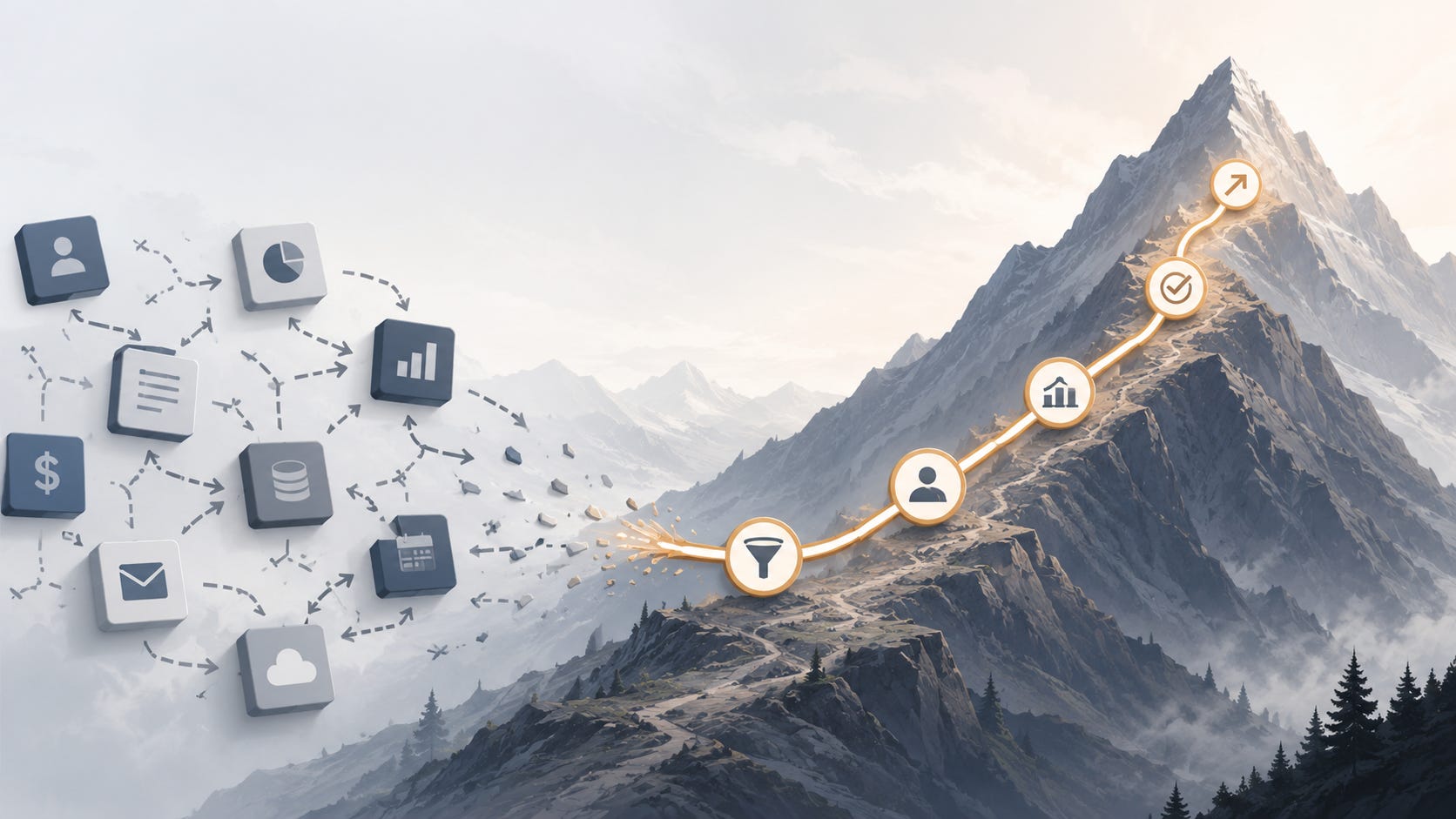
Enterprise software is entering a new phase.
For years, companies bought applications to support individual functions. CRM for sales. CPQ for quoting. ERP for operations. Case systems for support. Reporting tools to understand what happened across all of them.
Each system had a purpose.
But in many companies, the business process never became as connected as the software stack suggested.
That is the issue AI is now exposing.
The future is not just about buying less software. It is about expecting software to help complete the work.
Disconnected Software Creates Disconnected Work
Lead-to-cash is one of the clearest examples.
A seller manages the opportunity in CRM.
A quote gets built in CPQ.
Pricing exceptions go through approvals.
Engineering or operations gets pulled in when the request does not fit the standard model.
ERP receives the order.
Customer service inherits what was promised.
On paper, these systems may be integrated.
In practice, the process often still depends on people to interpret, validate, correct, and move work across the lifecycle.
That is not just a technology issue.
It is a workflow issue.
SaaS Created Access. It Did Not Always Create Alignment.
The SaaS era made software easier to buy, deploy, and scale.
It also made it easier for every department to optimize its own part of the process.
Sales tracks pipeline.
CPQ manages configuration and pricing.
Operations focuses on fulfillment readiness.
Finance focuses on margin and billing.
Service focuses on what the customer was promised.
Each function may be doing its job, but the customer does not experience the business as separate systems. They experience one journey.
When the internal workflow is disconnected, the result is delay, rework, margin leakage, order fallout, and customer frustration.
Eventually, the question becomes simple:
Why do we have this much software if the process still feels this hard?
AI Raises the Standard
AI changes what companies should expect from software.
Applications that only store data, create tasks, or add another handoff will be harder to justify.
That does not mean CRM, CPQ, ERP, or order management go away.
It means their value has to shift.
The value is not just having a system of record.
The value is whether that system participates in a workflow that drives an outcome.
Can CRM capture the right information early enough to guide the quote?
Can CPQ apply product, pricing, and approval logic without constant manual intervention?
Can Sales Order Management create a clean handoff into ERP?
Can service and delivery teams see what was sold, approved, promised, and ordered?
Can AI assist safely because the underlying rules and processes are clear enough to trust?
Those are the questions that matter now.
The Real Issue Is Disconnected Work
The decline is not software itself.
The decline is tolerance for disconnected, underutilized, low-context software.
Companies will not eliminate every application. But they will keep questioning tools that do not help work move across the business.
That is especially true in lead-to-cash.
CRM, CPQ, approvals, order management, ERP, and renewals cannot be treated as isolated systems forever. The business outcome depends on how well those pieces work together.
Before companies add more automation or AI, they need to understand where the current process creates friction.
Where does information get lost?
Where do teams reinterpret what the customer asked for?
Where do approvals compensate for poor rules?
Where does quoting depend on tribal knowledge?
Where does ERP receive an order that still needs cleanup?
Those are workflow problems.
And they are the problems AI will expose first.
The Takeaway
The next phase of enterprise software will not be measured by how many applications a company owns or how many users have access.
It will be measured by how effectively work gets done.
For lead-to-cash teams, the focus has to shift from systems to workflows.
From implementation to outcomes.
From software access to process clarity.
From disconnected tools to connected revenue operations.
That is the real opportunity.