

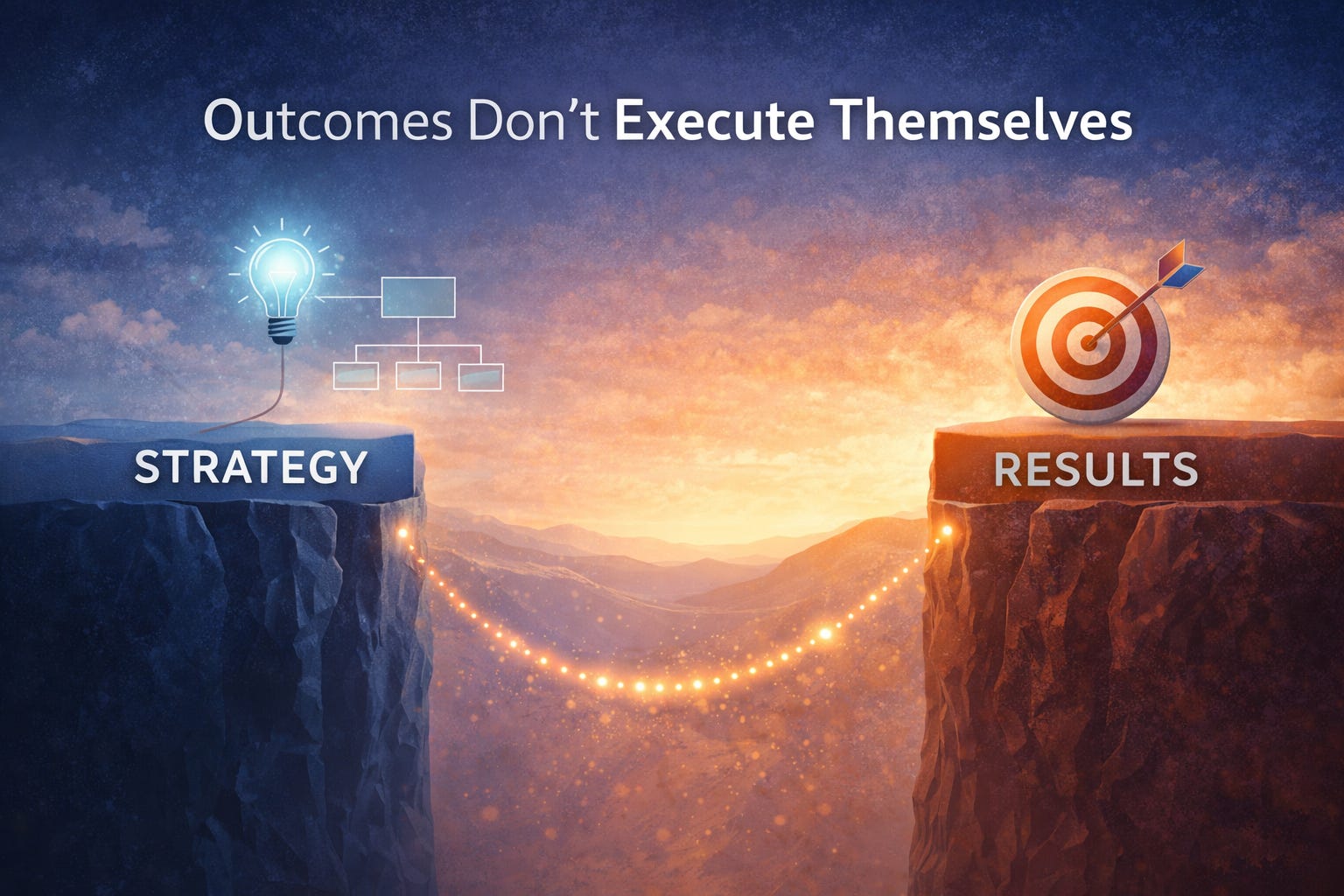
Most organizations agree on outcomes.
Grow revenue. Improve retention. Increase efficiency.
But agreement isn’t the problem.
Execution is.
Because while outcomes are discussed at the top, most of the organization is still operating on activity. And when that happens, even the right strategy breaks down in practice.
Why Outcomes Break Down
There are a few consistent patterns:
Goals are too high-level to act on
Teams are measured on activity, not impact
Marketing, sales, and customer teams operate in silos
No one clearly owns the outcome
So work expands. Activity increases. But results stay flat.
The Outcome Cascade
Organizations that consistently deliver results do something different. They connect strategy to execution through a clear chain:
Business Outcome → Driver Metrics → Activities → Systems
For example:
Outcome: Increase net new revenue
Driver Metrics: Pipeline coverage, win rate, deal velocity
Activities: Targeting, messaging, sales execution
Systems: CRM, automation, reporting
If these layers aren’t tightly aligned, teams default back to what’s easy to measure—activity.
And the rocking horse shows up again.
What to Measure (and What to Ignore)
The shift is simple, but not easy:
Move from volume metrics to impact metrics.
Not emails sent → qualified pipeline generated
Not meetings booked → opportunities advanced
Not campaigns launched → revenue influenced
Activity can support outcomes. But it should never be mistaken for one.
Where AI Fits
AI is a force multiplier.
But it multiplies whatever system it’s applied to.
If your operating model is aligned to outcomes, AI accelerates performance.
If it’s not, AI just produces more activity—faster.
More content. More outreach. More analysis.
Same results.
AI should accelerate a defined strategy, not replace one.
Outcomes Are Delivered Through Experiences
Outcomes don’t happen in isolation.
They are the result of how customers experience your business across every interaction—marketing, sales, onboarding, delivery, and support.
Pipeline quality is shaped by the buying experience
Win rates are influenced by the sales experience
Retention is driven by the customer experience
When experiences are fragmented, outcomes suffer.
When experiences are intentional and aligned, outcomes compound.
Many organizations try to improve results by optimizing internal activity instead of improving the external experience that drives those results.
The Role of Advisory
This is where most organizations get stuck.
They don’t need more effort. They need alignment.
Translating business outcomes into measurable drivers
Aligning teams around shared metrics
Identifying what to stop doing
Ensuring systems support outcomes—not just activity
Designing experiences that consistently produce results
That’s the difference between motion and progress.
Closing Thought
Most organizations don’t fall short because they lack effort.
They fall short because their effort isn’t connected to outcomes.
The companies that win aren’t the busiest.
They’re the most aligned—around the outcomes they want to drive and the experiences that deliver them.
That’s going to be our focus / theme next month, “Experiences!”