

Most companies manage outcomes directly.
Revenue. Pipeline. Retention. Growth.
They set targets, track metrics, and push teams to perform.
But outcomes don’t behave that way.
They’re not controlled.
They’re produced.
Outcomes Are Downstream
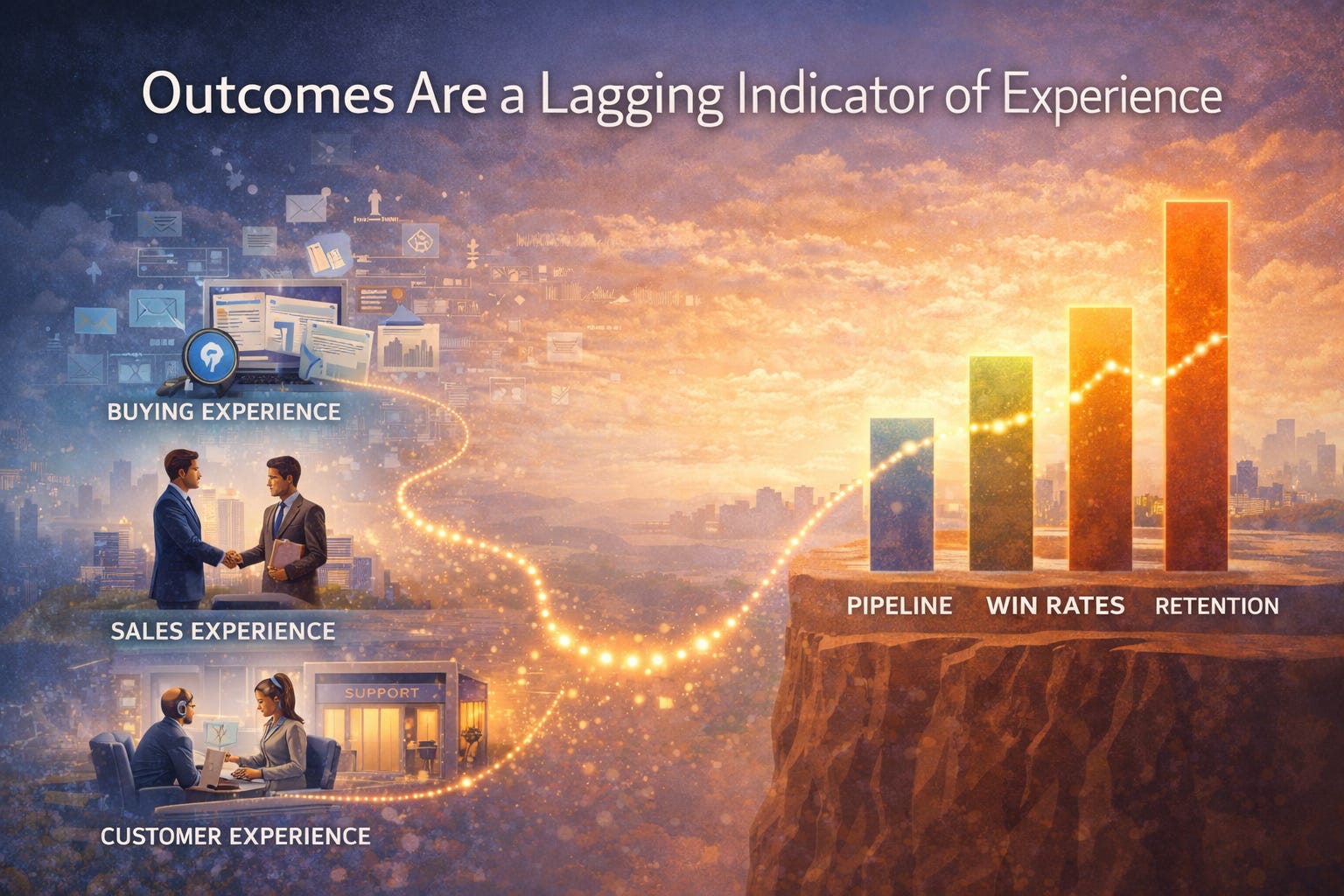
Every result in your business is a reflection of how customers experience it.
Pipeline quality reflects the buying experience
Win rates reflect the sales experience
Retention reflects the customer experience
When those experiences improve, outcomes follow.
When they don’t, no amount of internal pressure changes the result.
Where Things Break
Most organizations are not designed around experience.
They’re designed around functions:
Marketing
Sales
Customer Success
Operations
Each optimized independently.
But customers don’t experience functions.
They experience the gaps between them.
That’s where friction shows up:
Inconsistent messaging
Slow handoffs
Confusing processes
Delayed value
And that friction shows up later… as missed outcomes.
AI Is Compressing the Gap
AI is accelerating every part of the business:
Faster outreach
More content
More automation
More interaction
But speed doesn’t fix experience.
It exposes it.
If the experience is fragmented, AI makes it more visible—and more frequent.
If the experience is aligned, AI makes it more effective.
AI doesn’t change the system.
It amplifies it.
What Actually Drives Results
The shift is subtle, but important:
Stop managing outcomes as targets.
Start managing the experiences that produce them.
How easy is it to engage?
How consistent is the journey?
How clear is the value?
How quickly do customers see results?
These are not soft concepts.
They are the system behind every hard metric.
Closing Thought
You don’t improve outcomes by focusing on outcomes.
You improve outcomes by improving the experiences that produce them.
Because in the end, results aren’t managed.
They’re experienced.