

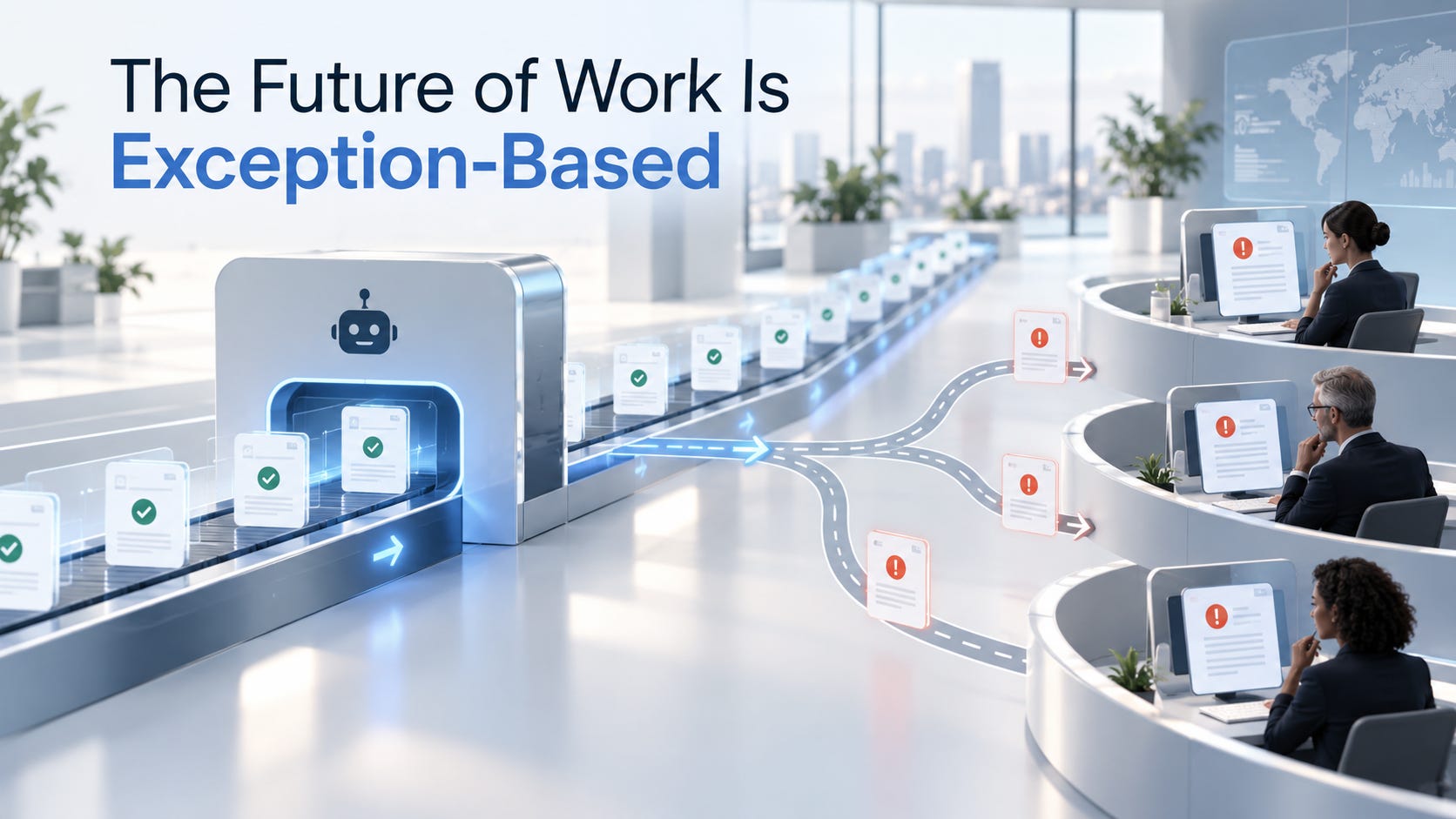
One of the biggest shifts AI may bring to business processes is not replacing people. It is changing where people spend their time.
For years, many workflows have been built around people reviewing, approving, entering, validating, and moving information. In a lot of cases, that was necessary because the systems could not reliably make decisions on their own.
That is starting to change.
As AI, automation, and modern platforms get better at interpreting information and applying context, there is less reason for a person to touch every transaction. The better model is often to let the normal path move automatically and bring people in only when something falls outside of it.
That is what I mean by exception-based work.
Stop Reviewing Everything
Take a common approval process.
A manager may be required to review every discount over a certain threshold, even though most of those deals are completely normal.
A better approach would evaluate the broader context. Is the discount within historical norms? Is the margin acceptable? Is the deal unusually complex? Does anything look materially different from similar transactions?
If everything looks normal, the process keeps moving. If something does not, the right person gets involved.
That is a much better use of human judgment.
The Same Pattern Shows Up Everywhere
The same concept applies across the business.
In quoting, only unusual configurations may need engineering review. In customer service, routine requests can be resolved automatically while more complex situations go to experienced people. In order management, normal transactions can continue without intervention unless pricing, inventory, credit, or fulfillment data creates an exception.
The value is not just that AI makes tasks faster.
The real value is reducing how often a person needs to participate in the process at all.
That Changes the Role of the Employee
If people are no longer spending as much time processing the normal path, their role shifts.
They spend more time investigating unusual situations, making judgment calls, solving problems, and improving the process itself.
That is a more useful way to think about AI than simply asking how many hours it can save.
The goal should not be to remove people from the process. It should be to put them where their judgment matters most.
Design for the Exception
This is where I think companies should focus.
Look at the work teams are doing today and ask how much of it is truly unusual.
How many quotes really require engineering judgment? How many discounts actually represent financial risk? How many orders genuinely need someone to investigate them?
The answer is often much smaller than the amount of work people are touching today.
That is the opportunity.
AI and automation should increasingly handle the predictable path while people focus on the situations where context, experience, and judgment matter.
Machines handle the normal. People handle the exceptions.