

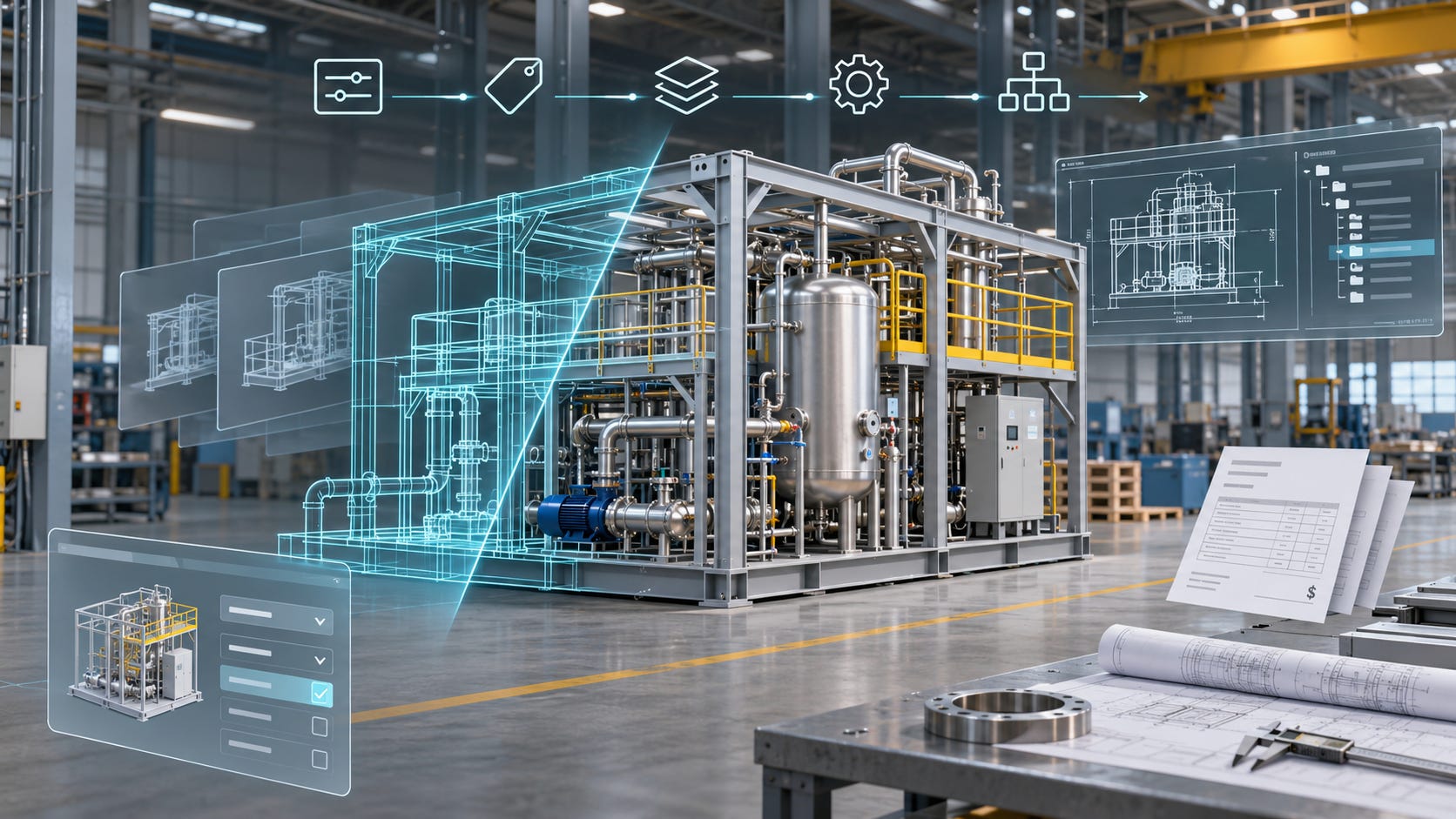
For a long time, visualization in manufacturing was treated as a sales aid. Give the customer a 3D model, help the rep show different options, make the quote easier to understand, and hopefully improve the buying experience.
That is still useful, but it undersells where this is going.
For Engineer-to-Order manufacturers, visualization is starting to become something much bigger. It can sit at the front of the commercial process, help capture requirements earlier, guide configuration, support quoting, manage revisions, and eventually feed the BOM or other downstream outputs needed to manufacture what was sold.
In that model, the visual experience is not simply showing the customer what they are buying. It becomes part of how the customer defines what needs to be built.
The configurator can start before the lead exists
Most manufacturing websites still follow a familiar pattern. A buyer reads about a product, downloads a spec sheet, and eventually submits a generic Contact Us or Request a Quote form. The CRM receives a name, company, email address, and maybe a sentence explaining what they need.
That creates a lead, but it does not create much context.
For complex engineered products, Sales then spends the first several conversations gathering information that the customer may have been able to provide much earlier. Dimensions, capacity, application, site constraints, product options, performance requirements, and other details all have to be collected before anyone can determine what the customer actually needs.
A visual configurator changes that starting point.
Instead of asking a buyer to fill out a generic form, let them begin defining the solution. They can explore the product, provide known requirements, make selections, adjust dimensions, or place something within a site or application. The experience can start anonymously and progressively capture more context as the buyer engages.
Once they save a design, request pricing, download a drawing, or ask for engineering help, the Web-to-Lead event becomes significantly more valuable. Rather than knowing that someone wants more information, Sales can see what they were trying to build and the decisions they already made along the way.
That is a very different kind of lead.
ETO often does not fit the traditional CRM model
The opportunity becomes even more interesting once the buyer moves into an active sales process.
Most CRM environments are built around a relatively simple structure: an Account has an Opportunity, the Opportunity has a Quote, and the Quote eventually becomes an Order.
Engineer-to-Order sales often do not work that cleanly.
A customer may be evaluating one broader project with several potential designs. There may be multiple sites, alternative configurations, phased purchases, different product approaches, or several quote scenarios before anyone knows which direction will actually move forward.
If every alternative becomes its own Opportunity, the pipeline can quickly become misleading.
A $5 million project with three $5 million alternatives is not $15 million of pipeline. It is still one $5 million buying decision with several possible ways to solve it.
That suggests ETO organizations may need to think about the CRM model differently.
Instead of simply:
Account → Opportunity → Quote → Order
the commercial model may need something closer to:
Account → Project → Opportunities / Designs → Quotes → Order
The Project becomes the broader commercial container. Underneath it, the business can manage multiple configurations, opportunities, quotes, sites, phases, and alternatives without treating every version as additional pipeline.
That makes it possible to answer a more useful question: what is the value and status of the overall project we are pursuing, rather than how many quote records have been created along the way?
Revisions need to be treated as part of the process
ETO selling is also highly iterative. Dimensions change, capacity requirements change, engineering adjusts the design, pricing shifts, components become unavailable, or the customer asks for another option to meet a budget.
Those changes are normal. They should not force Sales and Engineering to recreate the commercial process every time something changes.
A good architecture needs to preserve the history of a design while keeping the pipeline clean. Version four of a configuration should not become a new Opportunity simply because two dimensions changed. At the same time, a fundamentally different product approach or an additional site may represent a genuinely separate commercial path.
The system needs to understand that difference.
This is where visualization can become useful beyond the customer experience. Each design can have an identity, each revision can have a history, and each quote can be tied to the exact configuration it represents. When the customer makes a decision, the winning design becomes the basis for what moves downstream.
That creates continuity between what the customer asked for, what Sales quoted, what Engineering approved, and what Manufacturing ultimately builds.
The real value comes when visualization connects to the rules
A good 3D experience is not enough.
For ETO, the visual representation needs to be connected to the same engineering and product rules that determine whether the configuration is actually valid.
When those elements are connected, visualization becomes part of the configuration process instead of simply being a rendering of the final answer. Changing a dimension can affect allowable options. Selecting a component can change geometry. Adjusting the design can change pricing or required approvals. The configuration can also drive the BOM or technical outputs downstream.
That is where the experience starts to become operationally important.
The customer or salesperson is no longer just creating something that looks right. They are interacting with a model that understands what the company can actually build.
From website visit to BOM
This is the part of the opportunity that I find most interesting.
The same configuration can continue gaining context as it moves through the revenue lifecycle.
A website visitor explores a product and begins defining requirements. Once they save the design or request assistance, that becomes a lead with meaningful technical context. The lead moves into a Project where Sales can manage alternative designs and commercial paths. A specific configuration becomes a Quote, revisions are tracked without artificially inflating pipeline, and the selected configuration eventually becomes the Order.
From there, the underlying product definition can drive a BOM, CAD output, drawings, or other information required for production.
The value is in the continuity.
The customer does not need to re-explain the requirements at every stage. Sales does not have to translate an intake form into a quote. Engineering does not need to reconstruct what Sales thought the customer meant, and Manufacturing does not need to interpret a disconnected PDF or spreadsheet to determine what was actually sold.
The information becomes more complete as it moves through the process instead of being recreated at each handoff.
This also changes how engineering gets used
Engineer-to-Order will always require engineering expertise. The goal should not be to remove Engineering from the process.
The opportunity is to stop using scarce engineering capacity for decisions that are already understood and repeatable.
If every quote requires an engineer to determine whether a configuration is technically valid, Sales cannot scale without Engineering scaling at roughly the same rate. That becomes a natural bottleneck.
When repeatable engineering knowledge is encoded into configuration rules and exposed through a visual experience, customers and sellers can do more of the early exploration themselves. Engineering becomes involved where judgment is actually required: exceptions, new designs, unusual applications, and complex technical decisions.
That is a much better use of the expertise.
Visualization is becoming part of Lead-to-Cash
This is why I would stop treating visualization as a standalone feature.
For complex manufacturers, it can become part of the Lead-to-Cash architecture. It can improve lead quality, support project-based selling, manage designs and revisions, reduce unnecessary engineering involvement, improve quote accuracy, and eventually drive the technical outputs needed downstream.
The question should not simply be:
How do we add a 3D configurator to our website?
The better question is how to let the customer begin defining the product earlier, preserve that intent through the commercial process, and turn the selected configuration into something the business can actually build.
For ETO organizations still managing this through disconnected CRM records, spreadsheets, emails, CAD files, and repeated engineering handoffs, that is a much larger modernization opportunity than visualization alone.
Exploring visualization in your ETO process?
At Mountain Point, we help complex manufacturers think through how CRM, CPQ, visualization, engineering rules, and downstream systems should work together across Lead-to-Cash.
If your team is trying to improve Web-to-Lead, represent project-based opportunities more accurately in CRM, reduce engineering involvement in early quoting, or connect configuration more directly to BOM and production, see how we approach Lead-to-Cash architecture and modernization.