

Imagine you’re responsible for designing a new manufacturing facility.
You’ve spent weeks defining requirements, coordinating with internal stakeholders, and narrowing down potential suppliers. Finally, you visit a manufacturer’s website hoping to explore a solution.
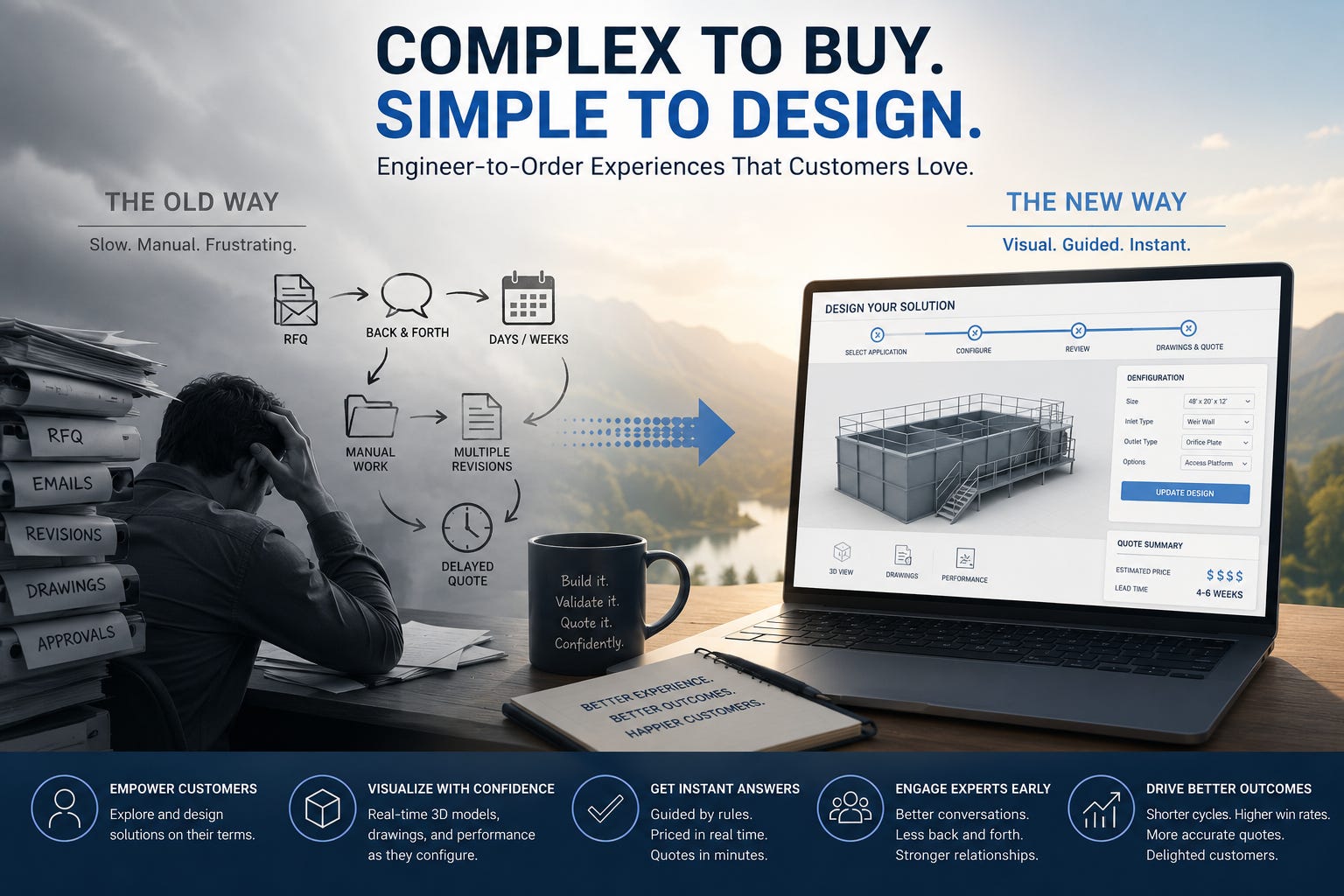
Instead, you’re greeted with a PDF catalog.
You download a specification sheet filled with product codes that mean nothing to you. After a few minutes of searching, you find a “Request a Quote” form asking you to describe your application in a text box.
You submit the request.
A few days later, someone emails with follow-up questions.
Another week passes before preliminary drawings arrive.
Engineering has a few concerns.
The design changes.
The quote changes.
By the time you receive a proposal, the momentum that existed when you first visited the website has largely disappeared.
For decades, we’ve accepted this as the cost of selling complex products.
But what if it isn’t?
Complexity Should Stay Behind the Curtain
Engineer-to-order manufacturers solve difficult problems. That’s what makes them valuable.
Whether it’s a stormwater retention system, an automated production line, or a custom piece of industrial equipment, these products are complex because the problems they solve are complex.
Customers understand that.
What they don’t understand—or appreciate—is when your internal complexity becomes part of their buying experience.
The customer doesn’t need to know how many engineering rules govern a configuration.
They don’t need visibility into approval chains, CAD revisions, or pricing calculations.
They simply want confidence that they’re moving toward the right solution.
The complexity belongs inside your business.
The experience belongs to the customer.
Think Less About Quoting and More About Discovery
Too often, manufacturers think of digital transformation as improving the speed of the quote.
That’s important, but it’s not where the buying experience begins.
It begins much earlier.
What if a customer could start with the problem they’re trying to solve instead of the product they’re trying to buy?
Instead of searching through catalogs and part numbers, they answer a few questions.
The system narrows the possibilities.
A visual model begins to take shape.
Dimensions adjust in real time.
Performance updates as selections change.
Engineering rules quietly validate every decision in the background.
The customer isn’t configuring a product.
They’re designing a solution.
By the time they reach out to your team, they’ve already explored options, understood tradeoffs, and developed confidence in the direction they’re taking.
That changes the conversation entirely.
The Best Engineering Is Invisible
When we admire great consumer experiences, we rarely think about the engineering behind them.
We don’t marvel at Apple’s supply chain every time we buy an iPhone.
We don’t think about Amazon’s fulfillment algorithms when we click “Buy Now.”
We remember how effortless the experience felt.
Manufacturing has an opportunity to create the same feeling.
Not by making products simpler.
But by making complexity invisible.
The engineering still exists.
The rules still exist.
The calculations still happen.
They’re simply working on behalf of the customer instead of becoming obstacles for the customer.
Self-Service Isn’t About Eliminating People
There’s a common misconception that self-service is about replacing salespeople or engineers.
It’s not.
It’s about changing when they enter the conversation.
Today, too many experts spend their time collecting information, correcting incomplete requests, and answering questions that software could answer immediately.
Imagine if customers arrived having already explored a visual design, generated preliminary drawings, reviewed budgetary pricing, and validated the basic engineering constraints.
Now your engineering team isn’t starting from scratch.
They’re refining.
Optimizing.
Advising.
That’s where expertise creates value.
Technology shouldn’t replace your experts.
It should make every conversation with them more meaningful.
Experience Is Becoming the Differentiator
Most manufacturers compete on product quality, engineering capability, and price.
Those will always matter.
But increasingly, customers are evaluating something else.
How easy is this company to work with?
Can I explore solutions without waiting for an email?
Can I visualize what I’m buying before committing to it?
Can I understand tradeoffs without scheduling another meeting?
Can I move from idea to confidence in hours instead of weeks?
The manufacturers who answer “yes” to those questions won’t just shorten sales cycles.
They’ll create trust.
And trust is remarkably difficult for competitors to copy.
The Future of Engineer-to-Order
Engineer-to-order will never be simple.
Nor should it be.
The products will remain sophisticated, the engineering will remain challenging, and every customer problem will have its own nuances.
But none of that requires the buying experience to feel difficult.
The manufacturers that lead the next decade won’t be the ones that remove complexity from their products.
They’ll be the ones that remove complexity from the customer’s journey.
That’s a different kind of engineering.
And it may become the most important one of all.