

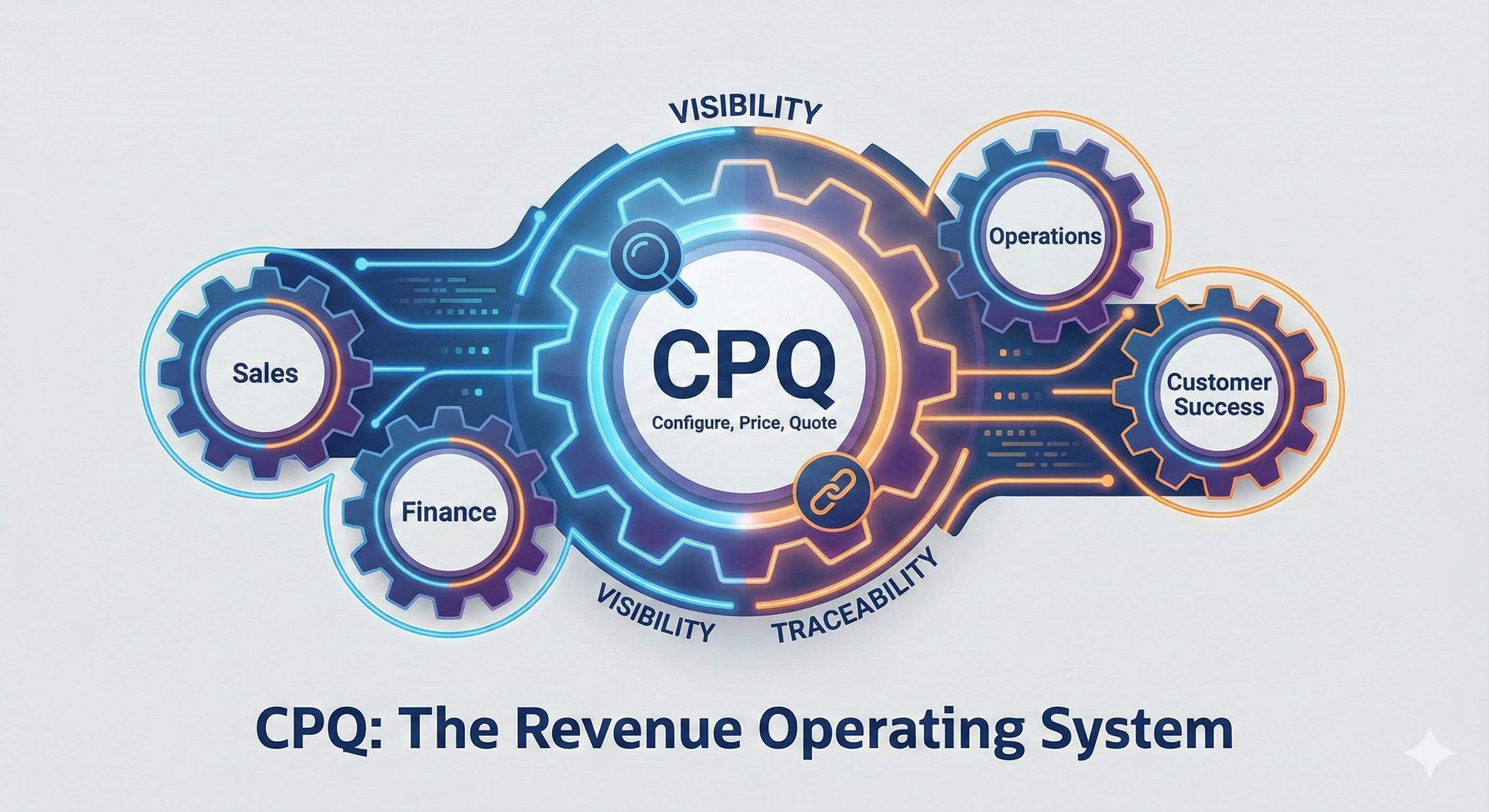
Most revenue problems don’t start with customers. They start internally—fragmented systems, manual workarounds, unclear ownership, and teams spending more time explaining numbers than acting on them. CPQ (Configure, Price, Quote) sits at the center of these issues, whether companies realize it or not.
When CPQ is implemented well, it becomes more than a quoting tool. It becomes the operational source of truth for how a company sells.
One Reality, One System
If Sales, Finance, Operations, and Customer Success all work from different versions of reality, execution slows to a crawl. Discounts don’t align, margins get questioned, and forecasts turn into debates.
A strong CPQ enforces one commercial reality:
One definition of a product
One pricing logic
One discount policy
One approval path
This doesn’t eliminate flexibility—it eliminates ambiguity. When everyone trusts the same system, decisions move faster because alignment is built in, not negotiated after the fact.
Visibility Before Control
Many organizations try to control pricing, discounting, or deal structure before they can clearly see what’s happening. That always fails.
CPQ creates visibility first:
Who is discounting
Why exceptions are happening
Where margin is being lost
Which products create friction in deals
Once visibility exists, control becomes a configuration choice—not a cultural battle. You can’t govern what you can’t see, and CPQ is where that visibility should live.
Traceability Equals Trust
When someone asks, “Why was this deal priced this way?” the answer should never require Slack archaeology or calendar invites.
Trust is built when every decision is traceable:
Why a price changed
Who approved a discount
What rules applied at the time
Which version of a quote the customer signed
CPQ provides an audit trail by design. That traceability reduces internal friction, speeds up approvals, and prevents second-guessing after the deal is closed. Finance trusts Sales more when the system explains the story without interpretation.
Manual Work = System Failure
Spreadsheets, copy-paste pricing, and “just this one exception” emails are not edge cases—they are signals of system failure.
Manual work means:
The system doesn’t reflect reality
Rules aren’t encoded
Ownership isn’t clear
The process can’t scale
CPQ should absorb complexity, not export it to humans. If people are routinely bypassing CPQ, the solution isn’t more training—it’s better design.
No Owner = No Progress
CPQ without ownership degrades fast. Products change, pricing evolves, and sales motions shift. If no one owns CPQ as a system, it becomes outdated the moment the business moves.
Effective organizations assign clear ownership:
Someone accountable for pricing logic
Someone responsible for product configuration
Someone empowered to improve workflows
CPQ is not “set it and forget it.” It’s operational infrastructure. Without an owner, it becomes technical debt disguised as a tool.
Tools Must Lower Friction
Every additional click, approval, or workaround increases deal friction. Sales feels it first. Customers feel it last—but most.
Good CPQ design does the opposite:
Fewer approvals for standard deals
Faster quoting for common use cases
Clear guardrails instead of rigid locks
The goal is not control for control’s sake. The goal is to make the right behavior the easiest behavior.
Meetings Resolve Gaps, Not Report Them
If meetings exist to reconcile numbers, explain pricing logic, or debate which quote is correct, the system has already failed.
CPQ should eliminate reporting meetings by answering questions upfront:
What’s the price?
What’s approved?
What’s standard vs. exception?
Meetings should resolve genuine gaps—new products, new pricing strategies, edge cases—not re-litigate what the system should already know.
Customer Friction Reflects Internal Design
Customers don’t see your CPQ, but they experience its consequences:
Slow quotes
Inconsistent pricing
Confusing proposals
Last-minute changes
Every bit of customer friction maps directly to internal design choices. If quoting is painful internally, buying will be painful externally.
CPQ is where internal clarity turns into external confidence.
Final Thought
CPQ is not a sales tool. It’s a revenue operating system.
When designed correctly, it creates one reality, builds trust through traceability, eliminates manual work, and lowers friction for both teams and customers. When neglected, it becomes a bottleneck that exposes every organizational misalignment.
The question isn’t whether CPQ matters.
It’s whether your CPQ reflects how your business actually sells.