

Every transformation starts with alignment.
At least it feels that way.
Everyone agrees the current process needs to improve. The system is too manual. Reporting is too hard. Data quality is inconsistent. Teams rely on too many spreadsheets, side conversations, and workarounds. The business needs better visibility, cleaner handoffs, and a more scalable way to operate.
That part is usually easy.
The hard part starts when the team has to define what “better” actually means.
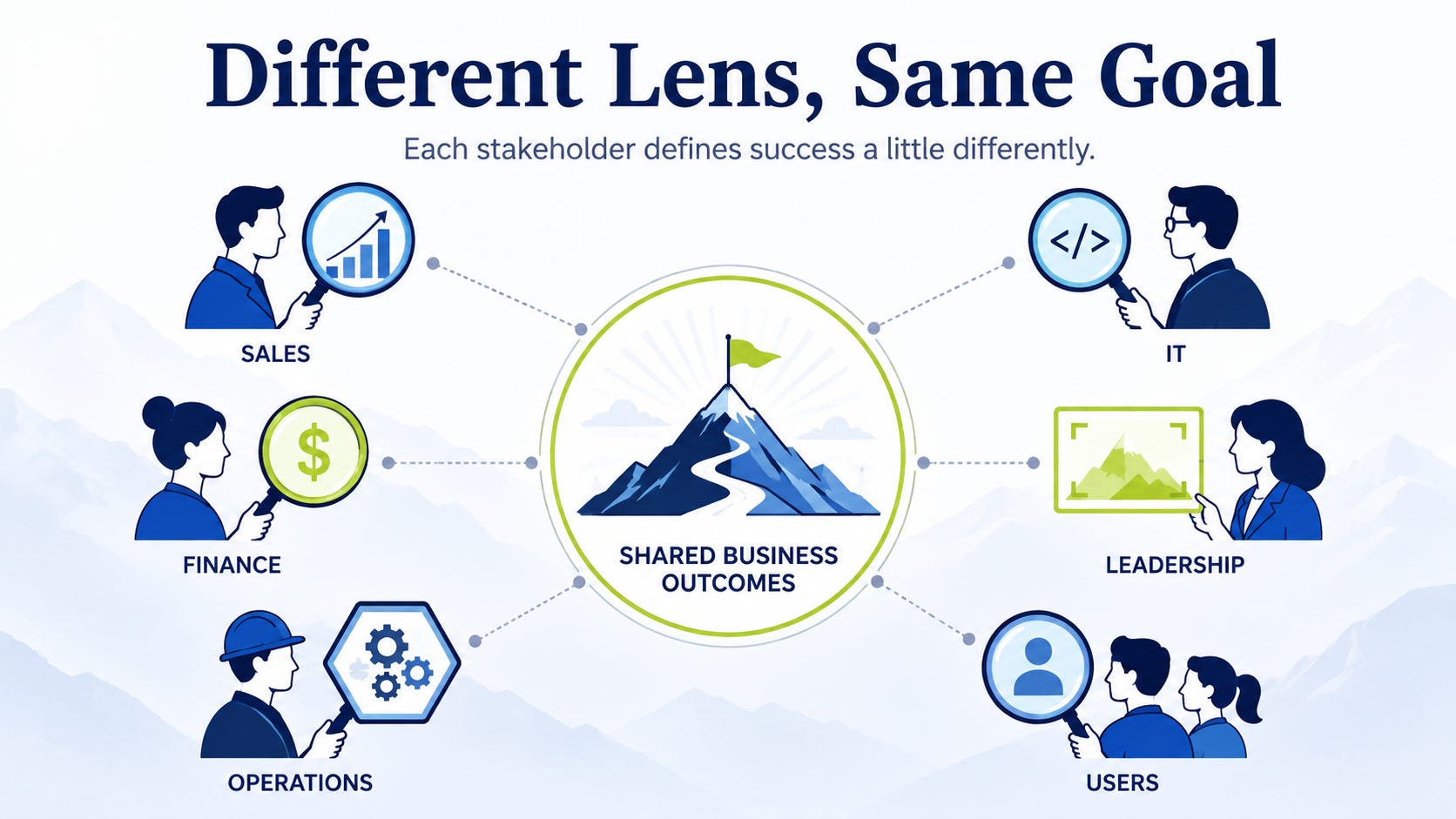
Because every stakeholder tends to see success through a different lens.
Sales wants the process to be faster.
Finance wants more control.
Operations wants cleaner handoffs.
IT wants security, scalability, and maintainability.
Leadership wants adoption, ROI, and measurable outcomes.
Users want the system to make their daily work easier.
None of these priorities are wrong.
But if they are not reconciled, the project eventually becomes a tug-of-war.
Vision-Level Alignment Is Not Enough
Most teams are aligned at the beginning because the conversation is still broad.
Everyone can agree on phrases like:
improve the customer experience
streamline quote-to-order
reduce manual work
increase visibility
create a better user experience
enable automation and AI
Those are good goals, but they are not operating decisions.
The real alignment test comes later.
Should the quote process add one more required field if it prevents downstream order issues?
Should sales have flexibility to override pricing rules, or should margin controls be tighter?
Should the system optimize for fewer clicks or better data quality?
Should an approval happen earlier to reduce risk, even if it slows the seller down?
Should the new workflow match how teams work today, or force the business toward a better future state?
That is where alignment gets real.
Stakeholders Are Usually Optimizing for Different Things
This is especially true in revenue transformation.
Sales often measures success by speed and ease of use. If the system slows down quoting or adds administrative work, they feel the pain immediately.
Finance measures success by control, accuracy, and margin protection. They care about pricing discipline, approval logic, and whether the business can trust the numbers.
Operations measures success by clean execution. They want complete information, fewer order issues, and less rework after the deal is won.
IT measures success by architecture, security, integration, and maintainability. They are thinking about whether the solution will scale and whether it can be supported over time.
Leadership measures success by outcomes. Adoption, efficiency, revenue impact, customer experience, and return on investment.
Users measure success by whether the new process helps them do their job without creating unnecessary friction.
The issue is not that these priorities conflict.
The issue is when nobody turns those conflicts into clear decisions.
Misalignment Usually Shows Up as System Feedback
After go-live, misalignment often gets blamed on the tool.
Users say the system is too rigid.
Sales says the workflow is too slow.
Finance says the controls are not strong enough.
Operations says the handoff is still messy.
IT says the business keeps changing requirements.
Leadership says adoption is not where it needs to be.
Sometimes the tool really does need to improve.
But often, the system is simply exposing decisions the business never fully made.
Who owns pricing exceptions?
What information is truly required before a quote moves forward?
Where should approval happen?
What does a clean order actually mean?
Which team owns the customer promise after the deal closes?
What tradeoff matters more: speed, control, accuracy, visibility, or flexibility?
If those questions are not answered, the system becomes the place where misalignment shows up.
Alignment Means Agreeing on Tradeoffs
Real alignment is not everyone agreeing in a kickoff meeting.
Real alignment is everyone making the same tradeoffs when the work gets real.
That means being clear about what the business is optimizing for.
If the goal is faster quoting, where are you willing to accept more risk?
If the goal is stronger margin control, where are you willing to add process discipline?
If the goal is cleaner handoffs to operations, what information has to be captured earlier?
If the goal is better customer experience, what internal complexity needs to be hidden from the customer?
If the goal is AI readiness, what data, rules, and workflows need to be structured enough to trust?
These are not technical questions. They are operating model questions.
And they need to be decided by the business, not buried inside configuration decisions.
Strategic Enablement Keeps Alignment Alive
Alignment is not a one-time activity. It has to be maintained.
The business changes. Users react. Leaders refine priorities. New requirements emerge. AI capabilities evolve. Customer expectations shift. What looked right during design may need adjustment once the system is live.
That is why Strategic Enablement Services matter.
They create the rhythm for keeping teams aligned after the project starts and after the system goes live.
That rhythm includes feedback loops, roadmap reviews, governance, adoption tracking, release planning, stakeholder check-ins, and continuous process improvement.
Support can fix a ticket.
Enablement helps the business decide whether the ticket points to a bug, a training issue, a process gap, or an unresolved tradeoff.
That distinction matters.
Because the goal is not just to keep the system running.
The goal is to keep the business moving in the same direction.
The Takeaway
Transformation does not usually fail because stakeholders disagree.
Disagreement is normal.
Sales, finance, operations, IT, leadership, and users should see the business from different angles. That is what makes the process better.
The problem is when those differences are never translated into decisions.
That is when alignment breaks.
That is when the system becomes the battleground.
And that is when transformation starts to feel harder than it should.
The companies that get this right do not avoid tradeoffs. They make them visible, decide on them, and keep revisiting them as the business evolves.
Because alignment is not a meeting. It is an operating rhythm.