

There is a lot of discussion about whether AI will replace CRM, ERP, service platforms, and the rest of the enterprise stack.
That is probably the wrong question.
The systems are not going away. What is changing is who has to think about them. Fewer users will need to understand which system holds which information or which application they need to open. At the same time, the people designing the architecture underneath will need to be much more deliberate about what each system owns, which rules apply, and what actions AI is allowed to take.
That shift is already happening.
The systems become infrastructure
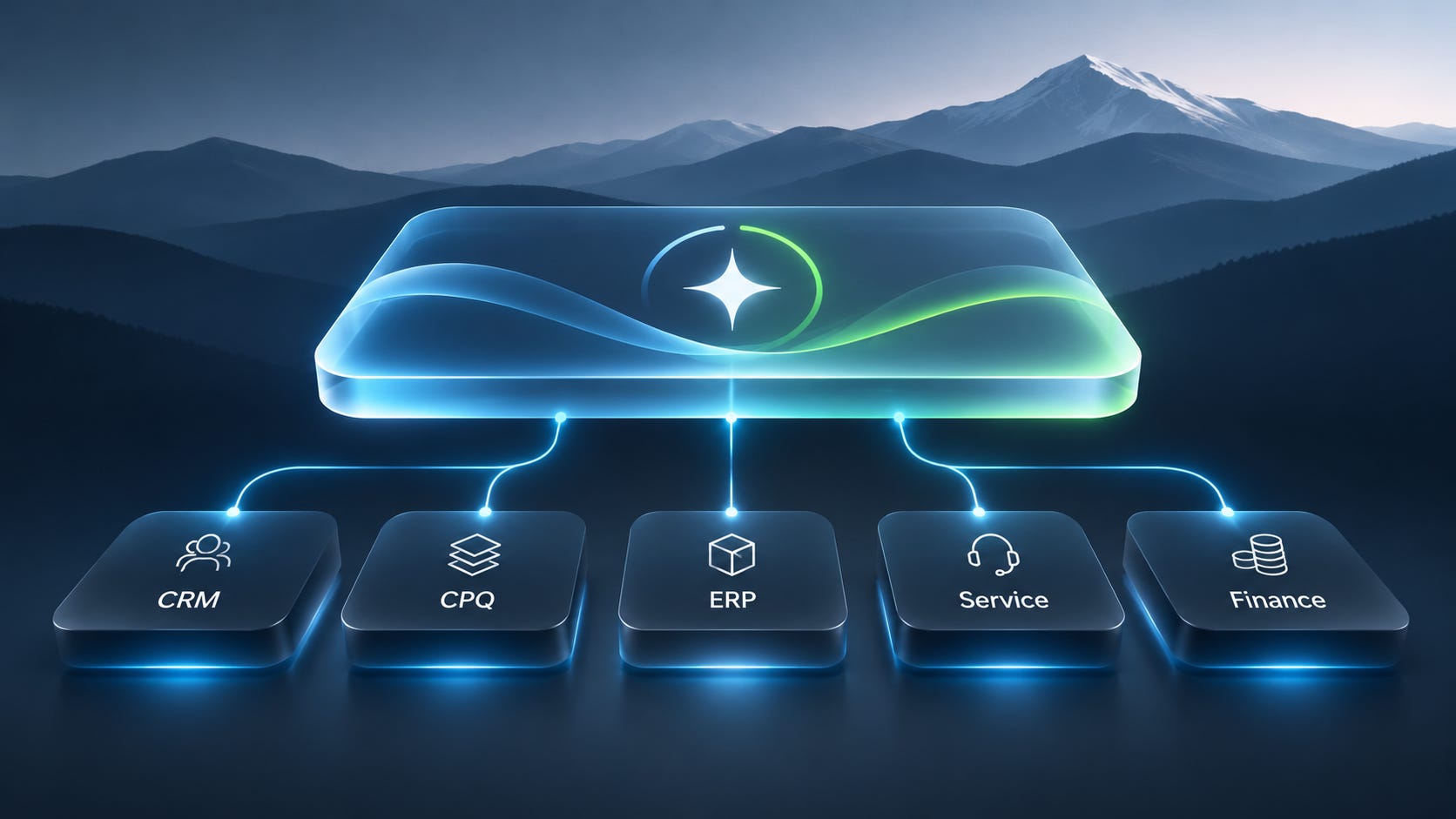
CRM, CPQ, ERP, finance, and service platforms are becoming the trusted infrastructure underneath the experience. They hold the data, business rules, permissions, and actions that AI agents need in order to work.
A user increasingly should not need to care which system is doing what.
They may simply ask:
Quote 40 units of the XL configuration for Acme, delivered by March.
From there, the engagement layer needs to understand the customer, determine a valid configuration, retrieve the correct pricing, evaluate availability, apply the appropriate rules, and determine whether approval is required.
That changes the architecture conversation.
Instead of asking which platform should become the center of everything, companies should be asking what responsibility each system should own.
CRM may own customer and commercial context. CPQ may own configuration and pricing. ERP may own inventory, production, fulfillment, and financial execution. Service platforms may own service history and operational workflows.
AI then becomes the engagement layer across all of them.
Where this starts to break
Consider a fairly common scenario.
A company keeps list pricing in ERP and customer-specific pricing in CRM. Over time, the two have drifted apart. Experienced salespeople know which source to trust for which accounts because they have learned the process over years.
Discount approvals work the same way. Above a certain threshold, approval goes to one person, except for strategic accounts where it goes somewhere else. There may be another exception based on product, geography, margin, or customer relationship.
People can operate around that ambiguity because they have context.
An agent cannot reliably do that unless those rules are explicit.
It will either need to stop and ask for help constantly or risk making the wrong decision.
AI did not create the ambiguity. It simply makes it much harder to hide.
Agents will not just retrieve information
This becomes even more important as agents move from answering questions to taking actions.
Finding a customer record is one thing. Changing a price, approving a discount, committing a delivery date, or releasing an order is something entirely different.
At that point, the problem is no longer just data access. It becomes a question of authority.
What is the agent allowed to do automatically? What requires human approval? What thresholds apply? Where is the decision recorded? Who is accountable when an exception occurs?
Most businesses have versions of these rules today, but many of them are distributed across applications, approval flows, documentation, inboxes, spreadsheets, and people’s heads.
That is not an architecture an autonomous agent can reliably operate.
Business rules become more valuable
If enterprise applications increasingly sit underneath an AI engagement layer, the value moves toward the logic those applications provide.
CPQ is a good example.
Configuration and pricing logic becomes much more valuable when it can provide the same trusted answer regardless of whether the request comes from a salesperson, customer portal, partner, API, or AI agent.
The screen matters less.
The trusted logic underneath matters more.
That only works when the rules actually live in the system rather than being completed manually after the fact.
A simple test
There is an easy way to see how ready your business is for this.
Pull one recent quote. Preferably a complicated one.
Then trace the decisions behind it:
Where did the final price come from?
Who approved the discount, and what rule determined that?
Which configuration rules applied, and where do they live?
If two systems disagreed, which one won, and is that authority clearly defined?
If those answers require several people to explain how things really work, you have probably identified the work that needs to happen before an agent can reliably operate the process.
That may tell you more about AI readiness than another maturity assessment.
Modernization has changed
Modernization used to be dominated by platform replacement and consolidation.
Increasingly, it is about making the architecture underneath the experience clear enough for AI to use.
That means establishing system ownership, making business rules explicit, exposing trusted actions, defining decision rights, and deciding where the engagement layer should sit.
The interface is getting simpler.
The architecture underneath it is becoming more important.
Fewer people may need to think about CRM, CPQ, ERP, and the rest of the enterprise stack. The people designing those systems will need to think about them more carefully than ever.
That is the work now.
Preparing your revenue architecture for this shift?
At Mountain Point, we help manufacturers and other complex B2B organizations determine what CRM, CPQ, ERP, Salesforce, ServiceNow, and AI should each own across the revenue lifecycle.
If your team is trying to make those boundaries clearer before introducing more agents and automation, see how we approach Lead-to-Cash architecture and modernization.